Showing posts with label quest. Show all posts

Saturday, 4 September 2021

#35 Quest: The Lonelines of Old Eremites

After writing the last post, I decided to take another step against my drive for theory. This is on the one hand to get closer to the root motivation for the whole project - practical quest design - and on the other hand a reaction to the simple fact that I'm slowly but surely running out of theoretical content that is not redundant. It might take some time and change until my theory batteries are recharged and then I'll surely continue with those larger text constructions.

The devil is in the details

Instead, these passages will be filled with short reading recommendations. The first one is "The devil is in the details" by former CD Projekt RED Quest Designer and Director Mateusz Tomaszkiewicz.

You can read it here.

It is old, true, but also one of the most accurate depictions of the craft I've ever read (point given, there aren't many depictions at all). Maybe this is due to the fact that I myself am quite CDPR-adjacent in many game development matters.

A Witcher 2 Quest: The Lonelines of Old Eremites

This mod was my first attempt at Witcher 2 quest modding and it turned out to be a long work with some problems not having been fixed even in this release. But oh well: Sometimes, projects and lines of thought need to be closed to make room for new ones.

I know for example, that the lighting is off. And that the NPCs and monster's names do not work correctly. But since time is limited and ressources at times inaccessible, I'll have to live with that. Maybe I will be able to address these issues in future mods.

Conclusion

I'm reinventing, but also modifying my own wheels and I think this is a sensible approach to my learning journey at this point: Right now I still have the freedom to explore in different directions, grasp the width of the field before step by step narrowing my focus. So I wouldn't be surprised if more such turns arise in the course of this project.

I hope you, too, take your time to do the things in your own pace.

Have a good time!

Wednesday, 25 August 2021

#34 Quest Givers

 Today we'll inspect and deconstruct the concept of a quest giver. Following that I'll start implementing the quest I devised last time.

Quest Givers

In stories, characters are one major source of movement/change. One specific figuration of that is a quest giver. Such characters provide the player with quests and are function thus as initiators of sections of game experience.

Initiation 

By their very nature quest givers are the main component for setting up a quest. Here the promises/ dissonances will be introduced, which need to be reflected in the subsequent progress/decisions and final payoff/resolution (see posts #17 and #20). The quest giving is the moment were the transition to a new story and experience happens and it is the designers task to make that transition right.

An initiation can also be seen in a more abstract context of going off into the Unknown, allowing yourself to learn something new, exploring unchartered territory. A quest giver in that sense is the liminal threshold, the access point to a new world or "palace of meaning". Even if the meanings are based on fictional signage, the meanings themselves are real and may be transferred to reality if they belong to a constelation that exists in realiy aswell.

On a more technical note, initiation by a quest giver carries the issue of "How to tell player this NPC is to be a quest giver?". There are various solutions to this

  • "have all quest-givers directly approach the characters automatically" and related to this: introduce the quest giver in the context of another quest

  • "clearly mark all relevant quest-givers somehow, such as having a sign float over their head"

  • "make the quest-giver stand in a prominent place and say things that suggest their function"

  • "don't mark quest-givers at all, players won't know if the character gives a quest unless they ask"

These are all taken in more or less verbatim way from the respective tvtropes site.

The above video shows an example of "automatically approaching quest givers" in Fable.

Trope Deconstruction

As the existence of the tvtropes site suggests, the concept of a quest giver is not particularly new to video games and indeed, it has been used quite often in many games so far. However especially in the early days of quest games these characters tended to be rather flat in their conception and often had a mostly functional use (at least that is my impression). This I found mirrored in books like the one Lee Sheldon wrote, where he devotes a large part of his section on quest givers on a commentary advocating that

There are many functions NPCs can have. But none of them need exist only as sterotypes or mannequins cut and pasted from town to town in a game.

A lot has evolved since 2004, and we find now that video games tend to divert more and more from characters that feel purely functional and lifeless. But I think it is an important lesson to have in mind for every designer newly entering this industry (as I am): For they probably didn't experience the origin of these developments and thus maybe need to understanding in retrospective why it is important to give special care to these NPCs.

Further Reading / Inspiration

  • Jeff Howard (2008) Quests - Design, theory and History in Games and Narratives, p. 26ff. Howard inspired my paragraph on the idea of quest givers as access points to new meanings.

  • TVTropes contributors (2021) Quest Giver. Link. The go-to site for tropes in media.

  • Lee Sheldon (2004) Character Development and Storytelling, p. 85. On this page, Sheldon discusses the shortcomings and needs for quest giver design of his time.

A Diabolic Witcher Quest: Implementation

So, for this post I've implemented the quest I devised in the last post:

 Have fun. It's better played in fullscreen.


Ideas for Feedback

  • How do you think the function of quest givers might be used in storytelling?
  • Do you think my implementation fit the tone of my design?

Conclusion

So today I talked about the topic of quest givers and their meaning to story and quest design. I found the idea of those figures as transition points very sensible. Furthermore, I implemented a second quest design as interactive novel of sorts. I'm content with the result, even though the result did turn out quite experimental.

Have a good time!

Sunday, 22 August 2021

#33 Quest Logs

 This post is about quest logs, journals, in-game quest descriptions and the like. Following some paragraphs on the topic I'll write a quest inspired by the ever glorious Diablo.

Quest Logs

In many games with a substantial narrative and goals related to space there is also some kind of quest log, oftentimes detailing what is to be done, why and (to some degree) how. It is also a good place to document things that have been done and give some contextual information.

From a media studies perspective, quest logs can be regarded as a visualization of the avatars goals/plans/ etc. It is thus a way to

  • give an in-game rationalization of the tasks given to the player
  • make the player understand her avatar better
  • focus on task selection, pursuing rather than remembering

In a way, one might say that quest logs are a very good quality of life feature for games. This is underpinned by the vastness of task management tools like Trello, todoist or Slack which all have the same goals and effects.

I'll continue with showcasing some of the components/features actual quest logs have. First of all it is to say, that such a log is usually based on visual communication (with the occasional sound effect). It is from this perspective then that quest logs shall be deconstructed here.

A list of quests, categorized

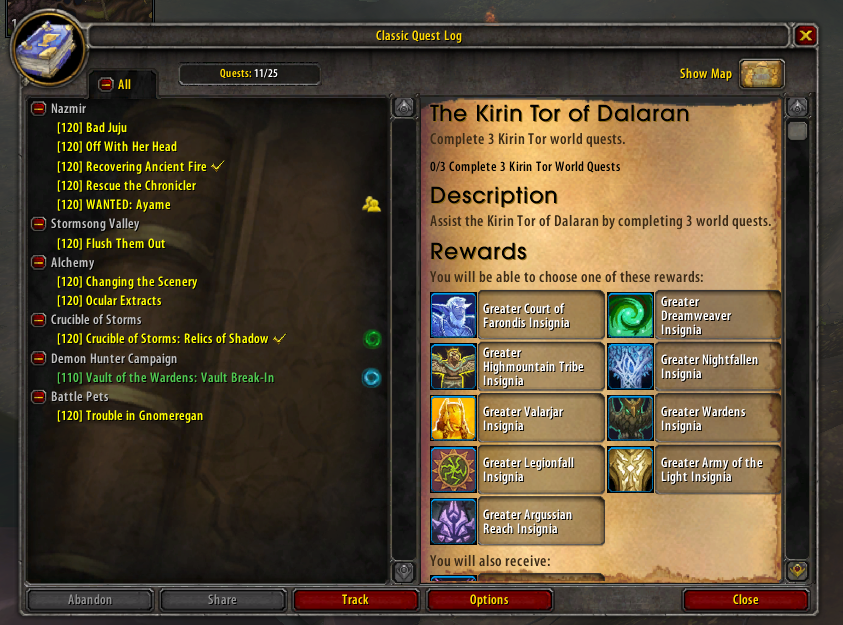
Probably the most common feature and component: A list of all discovered quests is queried and displayed as a scrollable list of signifying visual blocks, labelled with the respective quest titles. Such a list is usually either filterable by pre-defined filters or search strings, or it may also be ordered into collapsible sections. Usual categories are: main/side/.. quests, location in the game world, timestamp for when it was acquired or finished/unfinished.

A classic quest log (from WoW) where quests are categorized by location.

Quest properties

Hereby I mean all static and dynamic (changing on runtime) attributes a quest might have. These can be coded by quest name color (see example above), extra small texts/numbers or tracking symbols. For instance in the above image, the green color of "Vault of the Wardens" means this quest is deemed "easy". Of course there are other attributes besides difficulty might be displayed: belonging to base game vs. expansions, number of participants (see e.g. "Solo", "Solo only", "Small Fellowship", or "Fellowship" in LOTRO), or is/is not tracked. Often there is a possibility to set a quest to "(un)tracked".

Quest content

By selecting a quest often an overview is displayed: Containing such diverse elements as a dynamic description, dynamic objective overview, rewards, location on the map or links to fitting entries of any external view.

A dynamic description tells the context and set up of the quest, but is updated and extended at certain points in the quest progress to reflect new happenings.

A dynamic objective overview lists the current objective(s) and possibly also preceding ones.

A rewards section lists wha the player will gain when finishing the quest or from which items she'll be able to choose from (although I've found the latter only in MMORPGs so far).

So this is it. These are the features I encountered in video games so far (I think). But what about some design guidelines?

Quest Title Guideline: Regarding the quest title, I'd suggest that such a name should reflect the quests underlying theme(s) in some way, catch the quests mood - but not too explicitly (e.g. not spoiling things), rather in a convoluted or artistic way, like a piece in the puzzle you understand only when having experienced the main point of the quest.

Quest Description Guideline: With the quest description it is more about giving the player the information to understand what's going on in the quest right now. So one might provide the trace in the quest by motivating the objectives and explaining what happens. Ideally the description is also embedded in the games narrative itself (e.g. written from the avatar's perspective.

A Diabolic Witcher Quest: And Thou Shalt be a-Blessing..

My quest design today won't be for Diablo as a game but as a genre, I guess. As base game I'll assume some standard open world/story RPG like The Witcher/Skyrim/etc. Anyway, here's the - quite dark - quest:

Gameplay Event: Quest giver sees the avatar and calls them for help.
Scene with Quest Giver: They asked for help because their aunt, Leyla is acting strange of late.
Objective: Visit the aunt in her hut
Log: A busy merchant approached you on the market and asked for help with family troubles: His aunt Leyla showed strange behaviour of late and he himself did not find the time to deal with this situation, so he sends you.

Investigation at Hut: She's religious, avatar decides to ask neighbour.
Objective: Ask in the neighbouring hut about Leyla.

Scene with Neighbour: They tell she went to cathedral of the nearby city and was weirding since, eventually vanished into woods.
Objective: Trace Leyla into the forest
Objective (optional): Speak to the cathedral's priest.
Log: Leyla appears to have been very religious, even venturing as far as to the city to visit the cathedral there in bad times. Her neighbour though tells you she had last been seen wandering into the forest.

Scene with Priest: Aunt had a hard time with herself after the husband died, apparently he'd been burned by the local lord for witchcraft. The priest prayed for her thus and ended with the standard formula "And Thou Shalt be a-Blessing..". On right choice/force induction he'll tell you that she had a very bad reaction to that ending.
Log: From a priest in the cathedral you learned of Leyla's troublesome past. She apparently sought the priest for help at times. [If learned:] To the priests confusion, a blessing he gave her tremendously affected her.

Tracing Footprints into Forest: Leyla is found praying by an ancient altar.

Scene with Leyla:
[Option 1:] If the avatar didn't find out about the blessing and her extremely negative reaction to it, he won't be able to guess that it was the blessing that made her snap - she'll loose hope and sacrifice herself on the altar when the player leaves sight radius.
Log: When you found Leyla, she was already in a state beyond help. You could but stand by and watch her way of concluding with life.
[Option 2:] But if the information was gained, then the player will  be able to convince her of living in a monastery and the true reason for her unsettlement on the blessing will be unveiled: After a long life of not achieving anything being left alone she felt a god-like redemption like that would just not be right (even though unconsciously she of course wished it to be true).
Log: When you found Leyla, she was almost in a state beyond help. Discussing her blessing seemed to remind her of the earthlyness of her troubles and she decided to take a more peaceful road for the last times of her life.
Objective: Return to the quest giver.

Scene with Quest Giver: The avatar tells of what he learned and achieved and receives respective rewards.

Ideas for Feedback

  • Do you have any principles for the design of quest log contents?
  • Might the quest maybe be a bit too dark?
  • How could "good" vs. "bad" ending be more balanced into a morally grey difference? Is that even necessary?

Conclusion

I find quest logs interesting because they are a very direct interface to the underlying quest system. While the "real quest" plays out in the non-UI gameplay, the quest log is a means to access meta informations to the happenings (which is probably also one reason why they're more often abstract in their signs?).

Concerning that quest I wrote, well, I played Diablo II Resurrected the other day so I got inspired. Might be a candidate for turning into an inkle game next time, we'll see.

Until then, have a good time!

Wednesday, 18 August 2021

#32 Quest Objectives

 Today I'm gonna think and write about quest objectives. Indeed, making them distinct from quest goals will help understanding that matter more clearly, I feel.

Events, Goals and Quest Objectives

In my quest definitions so far one prevailing element is the existence and juxtaposition of events and goals. Since for me at least it never wasn't really clear how their relationships is, I'll try clarifying that in this episode.

Events and goals have in common that they are mental constructions, part of mechanisms in the mind. Events can be defined as abstractions and summations of movements perceived:

An event is thus fundamentally about the change from a previously perceived state. 

Goals on the other hand do not refer to the trueness/falseness of something in the world we perceive. Rather they make a statement about something one wants to be true/false therein:

A goal is about a future state that is wished to become true.

Note that unlike events, goals are bound to an actor of sorts. Events on the other hand are not necessarily originating from an actor only.

We see, that the production of fitting events is the means to fulfill a goal. We also see that the audience always needs to have at least one goal: That of wishing to continue to experience the story. This applies for all media, but mind how this plays out different in e.g. books and computer games: Usually the effort to continue the "book-experience" is trivial: You merely have to turn pages (those are the events needed). In games however the player's ability to participate in event triggering allows for much more complex ways of building the events necessary to reach the goal of "continue game-experience".

But of all this I've talked already lengthily in my post on narrative drive. I'll now turn my eyes towards quest objectives. First, what makes an objective different from a goal? Consider the question of goal-authorship in video games: It is obvious that the player's mind is the last instance of goal-creation. However those goals are oftentimes inspired or even afforded by the game: For example landmarks or those written goal propositions we get whe playing a quest:

Quest objectives in TES V: Skyrim. Source

These I call quest objectives and we see they are designer created and, as quest items, explicitely referenced by a quest system. By quest system I mean that part of the game's code that is responsible for revealing the events of a quest.

Here follows a short list of guidelines I think sensible:

  • The KISS principle: Keep it simple, stupid. Players shoudn't have to employ specific postmodern literacies to decipher the objective presented to them.

  • Thematic cohesiveness: As with all game elements, the objective too should feel fitting to the theme. One might use e.g. "thy" instead of "your" for a heavily medieval themed game.

  • Player expression: As with decisions, goals allow for expressing player thoughts. If a player likes a character, for instance, then you might insert an optional goal of talking to that character before moving on at an important point in the narrative.

Typologies

There have been several attempts to create typologies of (quest) objectives or goals in games. I'll present one here as a pool of inspiration without much further discussion.

Firstly we have Debus, Zagal and Cardona-Rivera (2020):

Choose, Configure, Create, Find, Obtain, Optimize, Reach, Remove, Solve and Synchronize

When reviewing books on quest design or video game storytelling such as Jeff Howard (2008) or Lee Sheldon (2004), then I find that those do not provide exhaustive overviews of such goals. Their value is much rather in the attempt of an overall synthesis of thoughts on their respective topics. What a luck that there are on the hand scholars devoting themselves to specifiv topics such as a listing and destilling of "imperative game goals" (Debus et al.).

Further Reading / Inspiration

  • Wictionary Contributors. event, goal. What a time to be alive for linguistically interested people.

  • German Wikipedia Contributors. Ereignis (event), Ziel (goal).

  • Lee Sheldon (2004) Character Development and Storytelling, p. 224ff.

  • Jeff Howard (2008) Quests - Design, theory and History in Games and Narratives, p. 101ff.

A Solarpunk Quest: Implementation Part 2

I'm going to continue my quest for quest implementations. Here is the latest progress:

And it is in its finished form, for now. I added some consequences to the choices and reused the part about tanking from the sun, which I introduced in the first version. Also, some CSS magic, as you see.

Ideas for Feedback

  • What design principles do you know or have for (quest) objectives?

  • Do you catch up with the story progress in "Sustain the Moon"?

Conclusion

Another post is another win. And I am content with finally having thought and talked about the event/goal/objective difference, whose relations were a point of annoyement to me for quite some time now. Also the feeling of having been able to prototype a quest so fast with inkle is great. I'll probably do that again.

Until then, have a good time!

Sunday, 15 August 2021

#31 Quest Items

 Shifting to some more - well - profane, or rather: 'classic' quest design topics. The first one in the line is quest items.

Items

So what are items in the first place? The wictionary tells me, it is a "distinct physical object" and, more specifically for video games, "an object that can be picked up for later use". I think I'd agree that in video games items are usually those which can be picked up and stored in an inventory. However it doesn't seem fitting to reality to say that every item may be used. So I'd go with:

items are distinct physical objects that can be picked up

This gives a good intuition for what is possible with them (some thoughts on meaning here are inspired by Jeff Howards book on quests (see below)):

  • distinct implies that the player is able to perceive at least some of its boundaries, form and what else might be part of an appearance

    note, that this allows for an assignment of an equally distinct meaning to this item and also for the relative stability of that: nonetheless assigning different meanings is probably one of the more interesting things to do with items

  • physicality gives items a very concrete existence, making them part of the spaces the player herself might pass through - it also forces certain aspects of appearance to be: a physical object needs a shape and a weight, for instance

    note, that this allows for literally embedding meaning into the game world: it is probably the basis to applied worldbuilding and environmental storytelling (see for instance this discussion of objects in the starting area of Cyberpunk 2077)

  • lastly, the player is able to pick up items and possibly also discard them. well, assumed that the player herself is able to move, then she may then carry this item through the game world

    note, that this is a perfect setup of items as a storytelling device: we can assign the item a meaning and tell the player to carry that meaning through a game world - possibly even showing interactions between item and game world or item and avatar. this is an easy way to make a meaning durable

Items in TES IV: Oblivion. Source

The whole concept of items is thus a great way to provide an extra level of meaning relations for a game. The meaningful moving around of items is also quite useful in the context of characters or other agents: Being able to move items aswell, they can give them to players e.g. as a gift or reward, but they might also buy or steal them from him.

Quest Items

Now what are quest items? To answer this, I'll cite a classification made by Jeff Howard. It goes as follows:

  1. The "lowest tier" contains items that are "largely useless" but give you "a sense of realism", so that which is known as clutter, junk or similar. Examples: garn, ashtrays, rotten tomatoes, ..
  2. The second tier includes "functional objects" which may be used e.g. for boosts, fighting or special game world interactions (maybe a magic lamp uncovering past conversations) 
  3. The third level is about quest or plot items. These play an essential role in the quest story or have "great magical power".

I'd like to disagree with the last definition and rather say that quest items are those, which are explicitely referenced by a quest system, "explicitely" meaning here that the concrete item is referenced and not "any sword" for example. This seems much more logical and useful to me.

Further Reading / Inspiration

  • Howard, Jeff. Quests - Design, theory and History in Games and Narratives. Chapter 4 - Objects. Link. Has a big focus on the literary, quests, meaning and symbolisms.

  • Sasko, Paweł. Lead Quest Designer plays Cyberpunk 2077! #1. Link. A big fundus of knowledge concerning mainly "storytelling, game design, quest design and psychology".

A Solarpunk Quest: Implementation Part 1

In order to actually implement a quest for a change, I downloaded inkle and wrote a system with hubs and dynamically addable, showable and deletable objectives. Then, I implemented the first half of the solarpunk quest from last time in it:

So this was nice and relatively easy. I'm thinking this might be a format in which I could also tell future stories here, instead of always leaving them in a non-implemented state.

Ideas for Feedback

  • In which ways have you used items in quest contexts?

  • Do you think my rather "quick and dirty" concretization of last post's quest design worked so far?

Conclusion

I am very satisfied with this post. It contained a theoretically inspired, but practical section on items and it featured an actual quest implementation (we haven't had those in a while ..). The link between them is missing, but I can live with that. For the future, I hope to continue with more such small-scale but worthy productions.

Until then, have a good time!

Wednesday, 28 July 2021

#29 The Drive of Narration

 This post is concerned with the potential of narrations to be captivating, such that you can't wait to see what's next.

Narration Drive

What do I mean by narration drive? Well, the drive (or drives) of a narration is that which makes the audience want to follow that particular telling of a narrative. This might be rooted in they way of telling (so this part is about storytelling) or in the content that is told (what the narrative is about). Below you find a previously seen graphic illustrating some of the terminological differences:

But now, what makes a telling or a narrative driving?

In my understanding, much of this has to do with what I call the experience cycle of human being. What you find below is a simplified synthesis of several game studies papers, twitch/youtube videos of story creators, blog posts and own thoughts.

Input / Trigger

As a narrative is told, steadily, bits of input (signs, movements) are given to the audience (the player). Upon perceiving them, they are interpreted on possibly several layers (see post #9) and now serve as a trigger to go on in the experience cycle.

Guidelines:

  • make the incoming flow interesting: pacing, contrasting meaningful things
  • every time a situation/conflict/arc is solved, open up another
  • funnel the audience from unit to unit

Addenda:

  • characters/agents are important because they can function as causes - film art  
  • build "characters with spines", give them a highest drive - andrew stanton

Learning, Knowledge

The informations is classified and integrated - learned - into existent mental models. It may well be the basis for a new complex of knowledge, such that e.g. the story "The Lord of the Rings" is demarked separately and can be recalled as one unit. Humans are able to imagine alternatives to what they already know - that way Tolkien was able to think of a fictional world in the first place. The in my view biggest propellers of curiosity and involvement are related to knowledge and summarized in the following

Guidelines:

  • obvious gaps of knowledge, things the audience wishes to know
  • informations that are meaningful to the storyworld, e.g. challenging a character's beliefs
  • carefully think about where the audience directs its attention: here the story should be told

 Quotes:

  • "A spectator comes prepared to make sense of a narrative film." - film art 
  • "it's this well-organized absence of information that draws us in" - andrew stanton
  • construct holes, missing spots, that are implicitly promised to be resolved
  • exploration is a rather un-guided form of resolving gaps

Motivations and Goals

This is the part that is at the heart of this post. Conceptually, here the drive, the acceleration of the wheel, the aquisition of energy for action is happening.
From the perspective of this section the others provide material for being driven and created special kinds of drives: flow continuation, meaningfulness, curiosity/wanting to understand. But abstracting those motivations, we can see that all of them are grounded by a common principle: Identifying a (imaginary or past) state of affairs, valueing it high - desiring it.
The last ingredient is uncertainty. If we'd know for sure and in which way a desire will be fulfilled, the it becomes pretty boring. But having an unknown variable, some gap to fill, makes it much more interesting, motivating.

Guidelines:

  • engage the audience, provide material to stimulate the audience's imagination
  • make the audience care about/value the story contents and/or the story progression

 Quotes:

  • "the audience wants to work on understanding the story but it doesn't want to know that" - andrew stanton
  • desires can be "seen as propositional attitudes towards conceivable states of affairs" - Wikipedia
  • create "doubt in the outcome" - andrew stanton
  • "we feel driven to know how the action develops, how the characters react and how it all comes out at the end" - film art
  • "Drama is anticipation mingled with uncertaity" -- william archer, via andrew stanton

-- ~ * ~ --

So, this shall be it for now. I know, I know, the part on agency is missing. It is missing because it is worth an article on its own, especially in the context of video games. For now we'll have to content ourselves with this overview, which by the way fits to many media, I think. In general - a lot of my thoughts actually stem from philosophical, psychological (among others) ways of thought, simply applied to video games.

Further Reading / Inspiration

  • Andrew Stenton: The clues to a great story Link. I'd advise everyone interested in storytelling to watch this TEDtalk

  • Bordwell, Thompson, Smith: Film Art, Chapter 3: Narrative Form. Even though concerned with the film medium, Film Art continues to deliver excellent material for my posts on narration.

  • Wikipedia: Desire. Link. I should probably write an article of praise about Wikipedia some time. Even though it has its problems.
  • Alexandra To et al. Modeling and Designing for Key Elements of Curiosity: Risking Failure, Valuing Questions. Link. Inspired the first version of the wheel of experience.
  • Katarina Gyllenbäck. Narrative Construction. Link. Another major inspiration for terms and ideas used in the wheel of experience.
  • Daniel Hessler. Game Design. Introductory course at the University of Bayreuth. Probably the main source of concepts and synthesizations for the wheel.

And many more... (this multitude of sources is the case for many posts, but I wanted to highlight it here specifically, since developing these thoughts really was a convoluted process).

A Skyrim Quest - Of Sheep and Flowers

I'll practically explore the concept of narrative drive in today's quest. Which is about magic sheep in a cave's glade, or at least that is the initial idea I've had.

Phase 1. Upon asking an innkeep about news, they tell the player of a monk in the tavern, who apparently has some problem with his tenple.

New sidequest: "Of Sheep and Flowers"
New objective: "Talk to the monk"

Phase 2. The monk sits in the tavern, devastated and muttering to himself. Upon talking to him, he first seems to have little hope, when he starts telling you: He is no monk but a keeper. There is a religious cave (not temple!) nearby which has been corrupted by a force he couldn't identify.

Decision: 1) "Speak on." 2) "I've heard enough of this religious nonsense"

When option 2) is chosen the keeper is offended and ends the dialogue. The player can retry infinitely often.

When option 1) is chosen, the keeper's spirits rise (he apparently hadn't someone encouraging him that often). He tells the player he himself would defeat the corruption but he isn't allowed to fight in religious places. However he will accompany the player through the cave. He asks whether the player accepts the quest.

Decision: 1) "Well, let's do this." 2) "This is too strange a job even for me"

When option 2) is chosen the dialogue ends. The player can retry infinitely often.

Otherwise, the keeper says he'll wait at the cave entrance and the dialogue ends.

Replace objective: "Meet the keeper at the cave entrance"

Phase 3. At the cave entrance a wall painting of flowers can be seen, next to it the keeper is standing. The location's name is "Cave of Flowers". Upon speaking to the keeper, he uneasily tells the player to not wonder about certain "oddities" they might see inside. The keeper becomes follower of the player.

Replace objective: "Investigate how to cleanse the cave"

Phase 4. Entering the cave, a lot of flowers and beautiful lightings coming from shafts in the stone can be seen. There are several shrines and places with benches arranged in circles. Closer investigation reveals draugr graves in the walls.

In one of those locations, a sheep is standing amidst a lot of flowers. It doesn't walk, doesn't eat and doesn't look around. The keeper tries to explain that this is one manifestation of the corruption: Flowers having been turned into sheep. Sounding devastated again, he speaks that the flowers don't know how to sustain themselves in a sheepish body and'll therefore die soon if the corruption is not eliminated.

Phase 5. Draugr actively start emerging from their graves and the lighing becomes darker, the number of sheep rises. The keeper says the draugr are part of the corruption aswell.

Phase 6. The pair reaches the innermost glade, being a new section called "Glade of Flowers", with the highest number of sheep. In it, a group of Talos-priests and common fighters is practicing some ritual. The group calls the keeper heretic, betrayer and start attacking. The keeper won't fight.

Replace objective: "Kill the Talos worshippers"

Phase 7. The group has been defeated. The sheep haven't turned back to flowers though. Discussing the events, the player-avatar is confronted with a

Decision: 1) "Kill the ship, before they die of hunger" 2) "Let's search the attackers"

If the player searches the leader, he'll find a notice detailing the groups hideout. Talking with the notice in his inventory to the keeper, will lead to him deciding to attack that hideout.

Replace objective: "Purge the Talos-hideout"

Phase 8. Keeper and player walk to the nearby hideout and fight through it. The end boss is a higher Talos priest, who carries a spell book with him. The spell transforms flowers into sheep and back. The keeper takes the book. He thanks the player for helping him and tells him to come back to the cave in a few days.

Replace objective: "Visit the keeper in a few days"

Phase 9. The player meets the keeper in the now sheep-free cave. He receives thankful words, gold and the spellbook from the keeper.

Quest end.

Ideas for Feedback

  • What thoughts/tips come to your mind concerning the topic and design of "narrative drive"?

  • Do you think the amount of to-be-crafted assets (locations, characters, models, mechanics, ..) for this quest is appropriate?

Conclusion

I don't think I have written a longer post yet - considering both text length and writing time. Also, I feel that there is still some polish and improvement of theory possible. But oh well, it is in the nature of such things to be quite difficult to grasp as worded concepts. Maybe future me will have a clearer view on this.

Until then, have a good time!

Friday, 2 July 2021

#26 Durability and Impact

"Half a Century of Poetry"

Of late, I've been repeatedly thinking about why I actually write all these posts. Why did the bard Dandelion write all his ballads? Why do people write down all their thoughts into countless diaries, sheets of paper, books?

One answer to these questions lies in the concept of durability, I believe.

Durability

That, which stays with us, even though the world and we ourselves might change - that is durable, persistent, it endures. The divide between duration and change is at the foundation of time, as can be seen in a previous post of mine on this topic where I found two ways to define time:

  • subjective: shows itself in the continous existence of observation and reality
  • objective: shows itself in the changes/durations that are happening in reality

Note that actually both definitions formulate time based upon the dualism of change and duration. The second one does this in an obvious way, the first implicitly refers to that with the term of continuation - in opposition to non-continuation which essentially is change.

Impact

Those things that are not or slowly changing have a more unconscious, contextual, surrounding impact. They are a room of many lower perceptions, background chatters that accompany us. If something is there only for a short time, then it grabs our attention, stands out due to its movement - it is more punctual, more embedded in the main thread of our stream of consciousness.

** A valuable lesson for quest design is thus: Use the players budget of unconscious and conscious perception capabilities such that she and you can author her the desired experience. **

The division between unconsciously/contextually and attentively/consciously
perceived information can be found in this Inception poster: Compare the
trees/cars with the main characters and street.

For quest design this is actually one of the central things to mind, if I think about it. Let's look at a formulation of the nature of quests again:

a series of connected goals and events, where subsequent elements are only revealed, when a previous event has happened (which includes reaching a goal)

The important components of quests are goals and events, where an event describes a change and a goal describes a striven for change not having happened. But there is an extra layer to this that we may perceive: Recurring changes, so the same or similar changes happening. In such a rythm of recurring changes in a timeline durability is present.

One of the main tasks of the quest designer seems thus to build changes and durations. I think that merely showing something often and preferably to the players conscious senses makes the thing more outstanding to him.

** So a second advice I'd give my future self is: Across all the changes happening in a quest, keep showing those things which should be the driving components of the quest enacted by the player. **

Let's see, if I can use those thoughts in practice.

Further Reading / Inspiration

  • Henri Bergson: Matter and Memory, see e.g. the corresponding wiki-article

  • Totten, Christopher W. (2019) An Architectural Approach to Level Design. Especially the chapter on rythm, pacing and structure.

A Cyberpunk Storyquest

For a course at my university I've been developing a quest/progression system, which I presented earlier here on this blog. Because it seemed fun and to showcase the system in a more focused context, I transferred it to some kind of a interactive novel that has serious Cyberpunk 2077 vibes.

I enjoy those colors.

A feature added are sub quests: There are now certain nodes in which you can enter a sub sequence of nodes. Planned features are a sight radius of visible nodes, a visualization of different node types and possibly a fmod integration (that would be cool). Here I want to write a story-quest for that project.

In the story, the avatar is on the run through a city, experiencing several moments of thought, emotions and external events on the way. While the story progresses and branches, immersion in the character is more easy due to staying with him/her so long. Slowly, the characters motivations and intentions are unraveled, drawing the player into roleplaying (like, actually playing the role).

The story shall be composed of several parts, maybe short-stories, the initial one defined by two questions: What are we up to? Will we achieve it?

Unconsciously, the constant, goal-oriented running through the city shall be the main topic, that endures most of the time. Consciously meeting the city and the avatar's inner shall be of concern.

I'll write down the story in section summaries. A section looks somewhat like this:

You're running
Faster and faster
The neon city lights shining
oh so bright

Each of these lines will probably have a separate blend-in. But now to the structure:

  • You're running in a cyberpunky city
  • Something is on your mind
  • There's violence nearby
    • Keep going
    • 1) Disturbed run
    • 1) Wasted opportunity of showing your fighting-power
    • Stop it
    • 2) You efficiently and powerfully disturb the violence
    • 2) An extra sprint is necessary
  • The avatar believes in his/her rising
  • Is being worth it?
    • Is life worth being?
    • Is love worth being?
  • Numbness, no answer
  • A moment of being tired
  • Trotting on, but wait...
    • That smell...
    • 1) The smell of totalitarism
    • Them sounds...
    • 2) The sound of oppression
    • Those vibrations...
    • 3) The movement waves of militech
  • Something's off - the pursuers?
  • Turning up the speed
  • Images of capitalistic force - an abyss:
    • Let the streamlined winds of speed guide you
    • 1) Muscles of steel accelerate, you sprint over the abysses air
    • Touch the earth and ascend
    • 2) Metal touches asphalt, hydralics press you into air
  • A bridge is shattering, the first prophecy of machine fulfilled
  • You take in all that is around you, rise up a hill
  • There is the king, a tower of matte gray and silver-white pillars
  • Determined reaching of the goal
    • You throw the atomic warhead
    • You run into hell's gate
  • The explosion
  • The aftermath
  • The ending line

Implementing this in the system would be rather tiresome, since every separately blended in line would need an event that has to be set up and wired manually - without visual scripting. That's why I won't do this now. Another reason is that I've written only the outline here, but actually lines are only there until (including) "A moment of being tired".

Ideas for Feedback

  • What other design principle might be formulated on the basis of the duration/change dualism?

  •  The short story is intended to be rather fast-paced. Do you think the concept might work?

Half a Century of Poetry

Granted, I didn't write about durability right now out of interest alone (even though I (guess one perceives that) do am intrinsically interested). This post carries the number 26 in its name, which is the half of 52, which is the number of weeks in a year.

Meaning, my "one quest design a week" is halfway through. What remains of the first half? What will remain at all? / What durability will this blog's content have?

To answer the first question: Well, a small encyclopedia of preserved thoughts for one. As I stated in the conclusion of post #24, a motivation for this is probably in the somewhat self-expressive need for putting thoughts down, develop and synthethizing them. Communicating those things to others is rather a nice side-effect.
Secondly, a feeling of achievement is there. I've written 26 posts with theory and practical share and I'm proud of each of them (even though some are more dear to my heart). Many of the theoretical things have brought advancements in my own thinking about the topics. I know from those blog statistics that I'm not the only one reading my ramblings. I've received feedback one or two times, and it was positive. I've been able to use the posts to advance my other projects. And, most importantly, I feel more confident doing quest design.
On the other hand: I'm missing bringing a quest from idea to implementation here. I tried doing this with that Witcher quest, but I didn't even finish the design phase yet. Maybe this just isn't the right environment to do this.

What will remain at all? I strongly believe that the positive effects noted above won't fade away. Whether my practical goals will be achieved better, I don't know yet. I'm unsure if the blogging will continue when the project is completed - a casual post here and there might be something. I'm hoping to improve, solidify my quest design skills and reach a certain level of competence. Like, being able to quick and dirty design and implement a quest in a selected range of engines, given any idea.

Freedom of Thought         

I'm sure this won't be a work like Julian Alfred Pankratz viscount de Lettenhove's "Half a Century of Poetry", especially not in importance for the history of word in its world. But I do feel - for myself, I don't expect others to feel this - a certain beauty in this. A beauty of allowing myself to progress and express in my very own way - chosen based on freedom.

Conclusion

The tempo isn't fast and decreases in small steps only, but I think the rate of posts on time is drawing close to zero. I'm missing a post on pacing and rythms yet, might be that there's something coming from that angle. We might also meet endurance again if I say something about cycles in (between) game/gamer or if I would take a look at memory.

Writing about this is very fascinating to me, because it is so closely tied to matters of life and death - when I'm dead, my self no longer endures, or at least I think so. And what endures in my self while I live, that is, what is relevant to me. And if it shows in my consciousness, then I can inspect that.

Well okay. There was also that Cyberpunk 2077 inspired short-story-side-quest-thingy, where I wanted to inject some design principles. But I realized, that the injection doesn't work when planning the high-level sections, but only when doing the concretest work, e.g. writing lines and decisions in this case. I'd like to finish this, but I fear that I'm kinda not doing quest design then any more: That is rather operating on that higher level. Ah, to have a writer who'd do that for me.

Enough talk for this already (again) long and thought/text-heavy post. I'm thankful for you, unknown reader, who might have discovered/seen and read this. I hope you found something of value.

Have a good time!

Monday, 21 June 2021

#24 Dialog Systems & Ocularis

 Today we're going to talk about dialog systems, their integration in quest systems, and how I implemented such a thing.

Dialog Systems

Let's hear what Chris Bateman has to say about dialog systems (or engines):

"A dialogue engine is the means by which a game speaks. This software mediates the delivery of all dialogue (and monologue) inside the game"

Consequently we may understand them as a component of the medium computer game, being in particular responsible for the channel of perception that is "speech" or "conversation".

So we usually have the possibility here to deploy speech lines, e.g. a sentence being displayed as a subtitle, heard out loud or seen as a (possibly synchronized) lip animation. Lines are usually not unconnected from each other but tied together into forms like trees, graphs, hubs and so on.

Many dialog system allow choices, in which the player is given with the possibility to steer the dialog flow. Oftentimes a list of written options is presented which can be scrolled and selected. There are special variants like timed choices, optional choices (on which lines follow that lead back to the same decision node), choices that lead to special mechanics (e.g. a boxing minigame) and so on.

Furthermore, additionally, moreover, especially nowadays many dialog engines tend to lean towards a more cinematographic style. Dialog partners/actors are positioned, there are fadings, blends and NPCs may walk around in the shot.

In general - the gaps between cinematic, in-game animated sequence, dialog scene and gameplay tend to blur more and more. This is for example visible when tracing CD Projekt RED's games. While Witcher 1 had that classic distinction quite rigorous and didn't make much use of cinematography, already Witcher 2 very explicitely employed cinematographic principles to tell certain things. In The Witcher 3 cutscenes and dialog scenes became almost indistinguishable because of the possibilities that were added to the dialogsystem. In Cyberpunk 2077, dialogs and cinematic sequences aren't separated from gameplay but flow flawless into each other.

Here is an example (Cyberpunk 2077 main quest spoilers), where the gameplay literally is the scene. Dialogs and choices dynamically pop up when moving around the space. The space is set up in such a way that the player is automatically drawn to look at certain things the right way.

The last point I'll consider here is the means of activation - when does a line (text or choice) fire? As Bateman puts it, "event-driven engines are by far the most common form of dialogue engines". So basically all those systems in which batches of lines are played to the player (haha) when some event in the game world is happening, say, a weather change or the player enters a certain area. this is the type I'll be implementing below.
Bateman distinguishes two more dialogue engine types: Topic driven engines are those in which the next lines is determined by the current context - which actions have been done, what items are in the inventory. It is less about when lines are played but which.
Dialogue trees, or maybe rather branching dialogues, are dialogue systems which allow for different subsequent lines depending on a choice made.

When you look at it, these three aren't actually completely distinct (in the sense of you can't have them at the same time) but rather different features a dialog system might have.

But now let's see, how an implementation might work.

Further Reading / Inspiration

  • Chris Bateman: Game Writing. Narrative Skills for Videogames. - Dialogue Engines

    In general, I can only recommend reading this.

Dialog System in Ocularis

Ocularis (very secret project) is basically an Action-Adventure-RPG - the avatar Leonora has fighting abilities, but she also talks a lot to herself and the ones she finds in the world. The world is constructed as a space of progression, and depending on that space-progression both fighting and dialogue-events are delivered. So this is how quests are in Ocularis.

And this is how the dialog engine works:

Overview of Ocularis' dialogue engine.

In every level an overall UI for dialogs is instantiated and communicated to all scenes. A scene object in Ocularis consists of 

  • a scene trigger (usually a box that the player may run into), 
  • scene content (text and choice lines), 
  • scene logic, which is responsible for blending in/out the dialogue UI, setting texts in it, adding/removing choice options and forwarding to the next line. And also dialogue-relevant player input is managed such as scrolling through choice options and selecting them is handled.

Here you'll see some in-engine (Unreal) screenshots of all that with explanations.

Example of scene trigger boxes in the level.

Screenshot of the line data structure.

Example of a scene content definitions with various text lines and a choice line.

Overview of scene logic.

The scene logic is event based: Every red node on the left is the entry point for a certain event. In the middle the scene start section is placed which  is activated e.g. by player overlap with the scene trigger box. The NextLine event is fired to calculate and deliver the next line. Text lines automatically call NextLine again, choice lines have to wait for player input, which is catched in the logic on the top left.

Dialog UI creation and propagation to scene objects in level.

A Quest Jam

Alright, this was fun. But I realized. This wasn't a quest design I wrote down - but this is what I want to commit to. So here is a short quest jam.

Scenario: Two friends meet in a café. Karla and Hannah. Karla is a notorious fast talker and always feels like there is not enough time. Hannah, our avatar, has light depressions, has just lost her job and wants to reveal that to Karla but won't feel in the right situation for that, which'll later cause tension between the two.

The level should contain the café and its surrounding and be entered upon about 9am. It should feel too open, the café has many glassy walls and little separation to other tables and guests. The player is funneled over the busy street, past a beggar who is pleading for money (representing Hannah's fear). Getting to the entrance she isn't greeted instantly, but has to call twice for someone. She's then guided to the unpleasant place and has to wait there some time, overhearing a conversation of a very successful man.

Finally, Karla arrives. She is in a rather pragmatic busy mood and starts talking long and much about her own life. The player at several times gets the choice to try bringing up her own issues, but Karla misinterprets that or quickly diverts in another direction. The noises are increasingly loud to Hannah, at some time she falls silent. At last Karla notices, but suddenly a fire alarm starts, chaos breaks out and everyone leaves the building. In the mess the friends loose each other. The player is directed to a silent place in a dirty side lane where Hannah sits down.

In a monolog with herself the player can express how he would talk to himself in Hannah's skin.

Ideas for Feedback

  • What is the meaning of life?
  • What kind of dialog system might fully evade the descriptions I gave?
  • What might be building bricks, toys to play around and construct quests with for brainstorm/ quest jam sessions?

Conclusion

What a long post. I'm wondering why I write so much about things already known or done. I mean, it surely isn't for potential readers alone. Maybe classic need for any self-expression? Maybe the strive to achieve something? I feel there's like a huge amount of ideas, concepts, text, music, images and so on in my head that just want to be put out into the world, simply because it would be kind of... stressful(?) to let them stay inside. Maybe this is about freeing my mind from the necessity of needing to let those things endure inside.

Well, on the other hand, of course, I enjoy documenting things for other people and myself to build upon that, to synthesize the knowledge and energy of people.

Those reflections are a nice closing.

Until next time, have a good time!


Thursday, 3 June 2021

#23 Queer Quests

 Queer quests! What is that, I hear myself ask. Pride month being about, I got inspired to connect a concept learned in university about games with quests in particular. In the end, such a quest will be written.

Queering Quests

What, is queering? What is - queer? I'll come to this right now. 

"deconstruct existing game genres to find the fundamental assumptions driving patterns of play then queer the genres by twisting, flipping, or undermining those conventions."

Deconstruction is something we've met already in the very, very beginnging: I began my first post with a paragraph that expressed belief in the absence of any final truths, existents or answers.

Rather, so I think, we humans ourselves define, based on our perception, what we deem "true", what "a thing" is or what is "existing". We utilize systems such as language, memory and any medium to let such constructions endure. And because we're having a habit of thinking in categories, differences and so on, beliefs too often tend to become structured and finite, which isn't a very good method of approach to meeting many things in reality. However constructions still are incredibly useful and probably the best tool to understand and orient yourself and exchange our approaches to being, so most of us will want to take that bitter pill of imperfection.

But there is hope! We come to deconstruction, which involves taking some constructed thing and not only just experience it as it is, but also look inside, break it, find its connection. Deconstructing doesn't mean to destroy things, but to analyse it, doing a close reading and laying open what it is and why it is that. That allows for improving, refining. It is a safety mechanism for our faulty (but necessary) constructionist efforts.

I find the question "how much deconstruction do we need?" hard to answer.

Quests are products of constructionist efforts. Differentiating events is a structuring which is produced that way. Proclaiming a connection between events is another structure. Saying there are goals to them is the next one. When I say there is a meaning to things, then this, too is a structural differentiation. The meanings to quest elements/the quest itself may refer to other distinct meanings in our memory (which makes quests potentially relevant for contextualization). Quests often are stories - when they're enacted the player has probably pursues certain goals with some mechanics - even more levels of structuralism and proclaimed borders ...

In a way, while writing this blog, I deconstructed my own intuition and previous knowledge of quests to re-construct to something new, improved.

So I think we understand that there surely is a lot to deconstruct when taking a quest as object of study and we also understand why that might be sensible. But now, what about queerness? Let's repeat that citation above:

"deconstruct existing game genres to find the fundamental assumptions driving patterns of play then queer the genres by twisting, flipping, or undermining those conventions."

Applied to quests, I'd say queering means to twist (etc.) a part of what makes a quest - determining und understanding those parts being possible by deconstruction.

Let's see how this might look in praxis.

Further Reading / Inspiration

  • Naomi Clark: What Is Queerness in Games, Anyway?, in "Queer Game Studies", 2017
    Origin of that citation I cited twice.

  • I found the wiki-article on building deconstruction very interesting in this context

A Queer Quest

Let's queer, that a quest may contain multiple events. What remains? If I adjust my quest definition:

a series of connected goals and one event, where subsequent goal(s) are only revealed, when previous goal(s) have been reached or the event has happened.

What are the consequences? Well, in order to say "a goal has been reached", some change in the game must has happened. There must have been a final event, that triggered "a goal has been reached". In our case, it will be the same event for every reached goal.

Now if the event were a computer action, then the quest would be quite boring, because the player wouldn't have a direct influence onto it. If we make the event a player action it becomes more interesting: We then have a quest, which progresses only if the player does one specific input action. The quest basically becomes a to-do list which the player may tick himself. Maybe there are two types of quests: player-event quests and computer-event quests to a game and both interact.

Here is a quest design, in which I applied those thoughts:


 There are three things worth mentioning here:

  1. The quest is partly inspired by Star Wars: Rebels season 3 episode 6 "The Last Battle"  

  2. The graphic looks interesting

  3. I reintroduced some events; the current quest design indicates an interesting mix of "player ticking" events and other events, who, however, never trigger that a goal was reached

I am quite interested whether there is actualy any game who does something like that and if so, how it feels. Maybe I'll find the possiblity to implement something like this somewhere sometime myself.

Ideas for Feedback

  • What is your understanding of deconstruction (especially if you're somewhat proficient in poststructuralism, postmodernism etc. etc.)?
  • How else could quests be queered without collapsing to meaninglessness (which is a problem)?

Conclusion

Thinking about and doing (de-)construction is one of my favourite free time activities. Guess I just have to live with that, but it really isn't that bad: I've heard they are just another synonym for doing science, artsy things and so on.

Until the very next time (proably not so strange as today, I might assure)!

Tuesday, 1 June 2021

#22 Non-linear Stories & The Witcher 3

Today I'm doing some theorizing on non-linear stories, finding a few design guidances usable for them - in particular those involving consequential player choices. The third part will cover how I change my witcher quest design to better accomodate those guidelines.

Non-linear Stories

At this point, I'd like to present some terms more "scientific" than "non-linear":

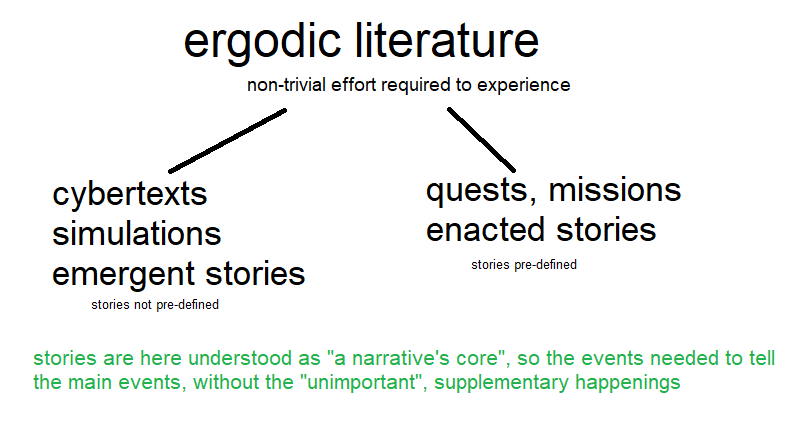
"In ergodic literature, nontrivial effort is required to allow the reader to traverse the text."

For example, ergodic literature is any text adventure where you are faced with decisions of what command to type next. This stands in opposition to books or movies where "what comes next" is usually quite clear. So an ergodic story is any story which you are not passively experiencing, but in which you have to give an effort to let the storytelling progress.

Cybertext is a form of ergodic literature, in which the text is determined by the interplay of a sign pool, a machine and an operator. So here interaction is of great importance: The "reader" takes part in creating the story, he participates in the storytelling. This is the case in many simulation games or games with a complex, dynamic system, where the concrete story cannot be predicted because the possibility space is just too high. Stories produced in such a way might also be called emergent.

If, on the other hand, all possible stories told by some computer game (being ergodic literature) are known from the beginning, then we might call these stories enacted. Quests and missions are very close to this type of story, since they define the key events and let the player progress through them with less important things being acted out by the player and only some (few) more important things being decidable.

Even though emergent stories have their own charm, we are on a quest design blog here, so this is why I'm mainly gonna focus on enacted stories here.

In ergodic stories, the audience enables the storytelling to progress.
Enacted stories allow the audience to choose between different branches.
Emergent stories let the player create her/his own stories.

As you can see, I understand story as "a series of related events" being part of a larger narrative which contains all minor happenings. For example, a character's mentor figure dying is most likely part of the story (and therefore narrative), while a character unconsciously moving some foot muscle while working is most likely no event relevant for the core story. It is, though, a happening in the overall narrative. Take this second fancy graphic:

Note that the terms I used here certainly have many different meanings
and relations in other places...

Note how I distinguished the narrative (that which has to be unveiled and be discovered by the audience) from the narration (that which is presented, told to the audience, from which it interferes the narrative). Story and plot are the core of each, while the happenings are "accessories", supplements needed to give the story context, a place, scene, world etc. to dwell in.

So while those happenings are not part of that which we usually remember from a narration, they certainly are necessary to make important events possible.

Alright, enough theory. What about those practical guidelines I promised?

So, here we go. This is a synthesized compilation of properties that enhance the non-linear aesthetic of a story:
  • decisions with narrative meaning (there need to be (communicated) consequences)

    There's a great appeal in having the feeling to shape a story. If there is no meaning to the story, then the decisions affects irrelevant happenings only, which might be cool too, but not as cool as changing the story. Communicating the consequences of a choice is very important to let the player feel that (s)he has made an impact.

  • decisions that feel personal (make room for player expression in the choices provided)

    Even better than being able to shape a story is shaping a story in a way that fits yourself. And if a dialog wheel does not offer you a choice that expresses your thoughts, than one feels detached.

  • amount of content/advantages following different choices should feel balanced in proportion to risk or and effort put into the choice

    If this is not given, then player might feel the need to always choose a certain way, because they want to experience the "most" content.

  • different branches and quests should not be isolated from another, but intertwining, mingling

    In reality, series of events do not happen independently from another. And if you do one decision but not another, then it's unlikely that the resulting world state will be completely different. The world doesn't revolve around a single actor.

  • some choices that create dilemmas

    If every choice is obvious to a player, then those choices may become boring and feel useless. Some morally gray decisions enhance player involvement and allow for feelings such as guilt and proudness when addressed later.

  • delayed consequences: players need to commit to choices they made

    This important to prevent players from optimizing their playthrough by reloading. This destroys  the emotional bond to a decision. Note how e.g. german let's player Gronkh becomes heavily invested in a certain choice in The Witcher 3 because of that: Link

While I'm certain - well, actually I know that there some other things that could be listed here ~ but I won't research and write down all of them right now.

Further Reading / Inspiration

  • Espen Aarseth: Cybertext: Perspectives on Ergodic Literature Link to Wiki-Article
    This work introduced the terms "ergodic" and "cybertext".

  • Henry Jenkins: Game Design as Narrative Architecture Link
    From this paper I borrowed the terms "emerging" and "enacted" story.

  • Many of the guidelines stem from this talk by CD Projekt RED quest designer Phillip Weber

A "Witcher" Quest - Part 11: Consequences

When I considered the current structural outline of my Witcher quest design, then I realized an inbalance concerning the amount of content following the first big choice. Furthermore, looking at the second big decision the consequences weren't really delayed, but rather immediate.

The story structure, as it was until now.

Let's fix that real quick:

The story structure, as it will be from now on.

So, what changed?

  • the content following the first grand decision is now balanced

    Both branches now have a roughly equal amount of things happening and a balance in good/bad things happening. E.g. in branch "Alene" Alene is freed from that bad situation, but Geralt won't be able to find the right murderer without the village becoming violent. In branch "The Contract" Alene dies, but Geralt can present the right murderer in a peaceful way.

  • swapping the quest branch is now mirrored

    By allowing to change from branch "Alene" to branch "The Contract", more balance between both branches is achieved.
  • the first and second grand decision now both have delayed consequences

    The first decision set (whether to help Alene or not) determines the fate of Alene and which ending follows when Geralt brings forth the true murderer. The second grand decision determines whether the village will be released from the tension of an unsolved murder or not.

Ideas for Feedback

  • Did my theory of story/narrative/.. match your intuition on those terms? If not, what feels off?
  • Should I maybe delete the possibility to change quest branches after the first grand decision?

Conclusion

Thinking about narration as something which is "told to the audience" reminded me of a thought that I really like: In computer games, the player participates in the construction of his own experience. He is part of the medium. Thus, he basically is partly his own narrator. I think that's quite cool.

Also, having said that stories are "a series of related events" being part of the larger narrative, we easily see the relation to quests, being defined by me as

a series of connected events and goals, where subsequent event(s)/goal(s) are only revealed, when previous goal(s) have been reached or some event has happened.

which is indeed a very story-adjacent definition. Maybe I'll find some other definition to test against some time.

I also am quite happy with the guidelines I found and how I managed to apply them. Those really seem like very useful (heuristic) rules. I'd like to find some guidelines for story irrelevant decisions in the future.

Until then, have a good time!