Maybe we still have-.. ... Time, Dr. Freeman?
Let's talk about time, then. It is a fascinating thing and a subject for many philosophical questions. But this won't stop me from trying my own take on it. I will present a kind of definition and add some other observations concerning flow/stillstanding, relativity and finally, where we find it in computer games.
The second part will be a quest design for Overwatch. I am looking forward to play around with those characters and places!
Time
Let us begin this small philosophy of time in games with some intuitive assumptions and thoughts.
- we experience something called reality (of which our thoughts, emotions, bodies and games are a part, so what I mean here encompasses inner and outer reality)
- we say the things we perceive in this reality exist
- we assume "we" exist, so there are multiple observers of the same reality
From this it follows that reality, in our intuitive understanding, is something objective, meaning not originating from one of those subjective observers. It seems as if there are windows in this reality, and to each window a continuous observation is attached, which is why a experience at all exists. But also, reality doesn't seem to vanish: Ever we are perceiving something, never is there nothing (until death?).
Time then, could be defined as that which shows itself in the continous existence of observation and reality. (Subjective Time)
 |
| If somebody posted it as a quote in the internet, then it's gotta be true: Subjective time can become faster. Source. |
But there is a more pragmatic definition we could do. Why would we want to do this? Well, for some applications it is rather difficult to do anything productive in reality with time as I explained it above. For example, think of sleeping eight hours without dreams. If you wake up, it won't seem as if eight hours, because you haven't been perceiving that much - the window was shut for some time, so to say. But in reality things have moved on in those eight hours: Your cat was on the hunt, the earth has rotated further, on the other side of earth people went to work. For someone managing a world-wide company thinking only in subjective time would be desastrous: Then he would have to assume that in his hours of sleep nobody could do anything. So maybe a more regular time definition is actually useful too:
Objective Time shows itself in the changes/durations that are happening in reality.
 |
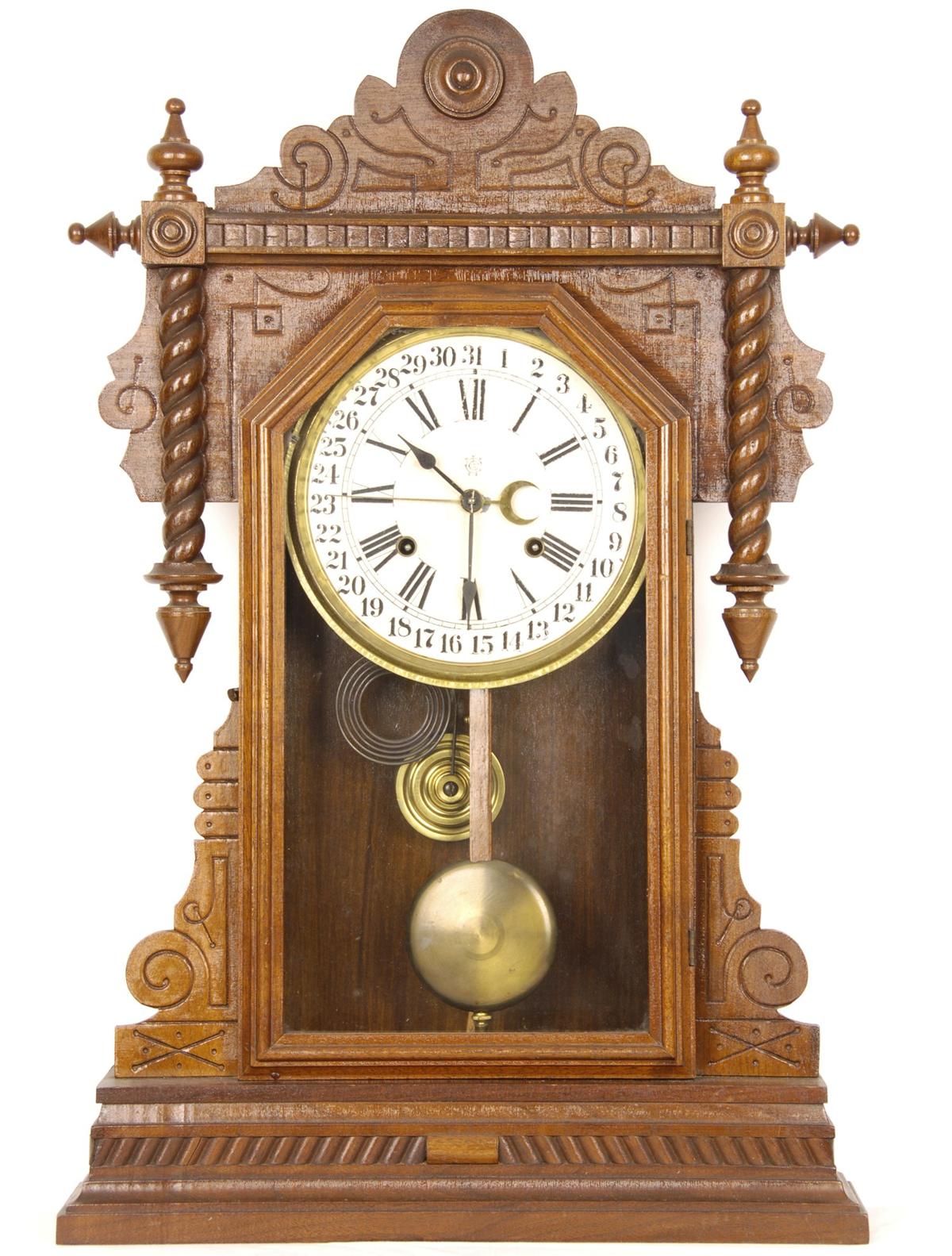
| A pendulum clock measures time via the change created by its swinging pendulum. Source |
This is the time we find measured by clocks, calendars, music notes and so on. We take something changing very regularly (e.g. a pendulum or certain electron transitions) and claim: That what happens between one tick and another, that is a duration, a unit of time. This is not subjective time, because clocks in reality keep ticking, even if we don't observe them.
Some notes:
- Subjective time is able to flow fast/slow/stand still/skip in relation to objective time. This seems to fully depend on reality: How fast our thoughts are, in which state of consciousness we are, how crowded our perception is, in what mood we are, etc.
- My thoughts are inspired by presentism and Henri Bergsons philosophy of duration. I don't actually know if he and I make the same distinction, but he is an inspiration nonetheless.
- We could also assume that all these intuitions are wrong and instead we
create all of "reality" by ourselves and there are no other "observers"
and reality does therefore not exist while we're asleep (I'm referring
to radical constructivism). While I don't think either side is right/wrong, I find it much easier to explain things with an intuitive perspective.
- We perceive structure in time (moments, durations, days, eternities, ..) in a very analogue way to how we structure e.g. visual (point, line, plane, texture, ..), performative (press, reach, wander, ..) or cognitive (meaning, statement, conclusion, mental map, ..) inputs.
For each input "dimension" it would be interesting to think about whether the structure we perceive stems from differences in the input or from us, and whether we'd want to change things relating to that way of perceiving. (inspired by Kant) - Time-Pacing is the ((un-)planned) perceived arrangement of structure in time. Based on objective time this might refer to the fact that a cutscene took 47 seconds of time. Based on subjective time this might mean that we think the cutscene took an eternity to watch.
Okay, enough of this serious philosophy! Now for some application on games and quests.
Time in Games and their Quests
Games, as I explained in previous posts, are two-fold. There is the unplayed game containing the materials and rules needed and there is the played game, which I'll define here as follows:
A played game is a process in which rules, materials and player input are used to produce player-perceivable output.
The game experience then encompasses everything in the players mind related to the played game (notably the perception of the played game).
Now, what times can we find here? First of all, we have what I call the global time, which is the time of our usual clocks, based on some atomic changes/durations somewhere. But then we also have a game time which is seen in the played game: It is, after all, a process in which things are happening, changing, moving. So if we're sitting in front of our favourite PC game, we might aswell track time by the change that has been happening while we started playing it - for some WoW-players this indeed might not seem so far-fetched. The third time is the player's subjective time where the measure is the continuity of the player's own experience. This ist not necessarily synchronous with game time of a game he's playing: Different player might experience time in games different due to personal mood, involvement, etc. Note that global time and game time are both objective times.
To make things more complicated, there can be different times in the fictional world of the (computer) game aswell. A day in the strategy game Europa Universalis may endure only a second, and sometimes time periods are skipped (e.g. fast travel) or past events of that world are presented (e.g. flashback). So we have a fictional time too, which is the point in time of the fictional game world we are experiencing. Due to it being fictional, we can do things with it that do not happen like that in reality.
 |
| At this point in Half Life 2, fictional time stands still - but game time is still running. Source |
Using game time and fictional time can thus be used as a tool to influence the player's experience. The durations/changes that a game/quest designer provides via a game's communication channels can have a big influence on both kinds of time.
On the other hand - the player will always be author of game/fictional time too, since he induces changes through his actions. And, even more importantly, the subjective time of his game experience is defined by what is happening inside his mind - and some of the things happening there are usually out of control for a game/quest designer (what a relief!). Sure, we can predict the player's thinking by using psychological insights, but the thinking itself (or feeling, remembering, ..) will be done by the player, not by the game (being the game/quest designers proxy).
At last, if we design a complex game that is meant to produce things that we as a designer didn't think of (e.g. Minecraft), then we might give the computer or randomness credit for the thereby constructed changes/durations too.
With these thoughts I will end my theoretical inspection of time today. But, since it is such a defining aspect of games, you can be sure that there'll be more posts on this topic!
An "Overwatch" Quest
BlizzCon is near and I'm thinking of a mission design for Overwatch. Before getting into details, I did some research. Overwatch "is a multiplayer team-based first-person shooter" (Source) which is set in a world having some similarities to ours. The game resolves around the organization called "Overwatch", a higly specialized group of people determined to make the world a better place. The antagonists are the terror organizations called "Talon" and "Null Sector", where the former pursues conflict in order to strengthen humanity and the latter is an uprisal of the so-called omniacs. Omniacs are essentially the robots and AI's of that world, of whom some are treated badly by some humans. Overwatch itself was formed in response to a huge conflict between men and machines, the Omniac Crisis. Narratively, the game is heavily focused on characters and locations appearing in this world, because the characters are, who the players are playing, and the maps on which they play are part of that fictional world. But the main focus probably is gameplay: Strong flow experiences can arise through the dynamics happening in a match.
 |
| An overview of all heroes that are playble as of now. Source |
Now how to do a mission design for a Overwatch? Luckily enough, the developers have thought of and implemented mission-like gameplay modes themselves.
Next to regular gameplay, the Overwatch Archives exist, currently a set of three missions where players play fixed heroes on a modified version of a regular map. Here are some aspects of those missions:
- you play as a team against various (at times special) AI-enemies
- a small story is told, grounded in the Overwatch universe
- downed teammates can be revived
- there is a lot of dialogue
- there is an intro, an outro, some smaller cutscenes and some scripted events
- the characters may have a special skin
- the map is modified into a more linear passage, audiovisuals are changed to fit the story
- objectives may be given by other characters over a radio
- goals are displayed sometimes on the top of the screen
- there are several stages to a mission
With the announcement of Overwatch 2, it was confirmed that the game designers opted to expand on that mission style of gameplay. They showed sneak peaks of the so called "Story Experience", of which later an almost complete playthrough was released: Link. I will gather some of my and the reporter's thoughts on aspects of the shown Story Experience here, but only those that are different/additional to the Overwatch Archive missions:
- each mission has an intro, an outro, a boss battle, item usage, and talent selection
- as the map progresses, boxes are teleported in, where players can select an item
- the maps seem to be crafted specifically for the Story Experience
- there are multiple maps/levels to a Story Experience
- characters are fixed for each map
- there is a lot dynamic destruction in the environment
- what was good about the shown mission:
- lots of team coordination
- spaces prepared for battle
- spaces designed for the characters
- some aggressive enemy spawns
- interesting enemies
- other heroes appear in cutscenes
This provides a good framework for a mission design. Since creating a map is always quite demanding regarding time, I opted to choose an already existing one, namely Eichenwalde.
But first things first, I originally started with choosing the characters that I wanted to be a part of my mission. The criterions for choosing were few: There had to be a chance that they might embark on a mission together and it should be possible to tell something interesting using their dynamics in the chosen space. Ever since I read the Binary comic my interest in learning something about the relation between machine-sceptic engineer Torbjörn and nature loving war-machine Bastion had been kindled. From Torbjörn the step wasn't great to arrive at the warriors Brigitte and Reinhardt - one being his daughter and the other her godfather and a good friend of Torbjörn. In addition, this way we have one tank, two attackers and a healer, a mix that has been applied in the Overwatch Archive missions too. But now to the map: Since Eichenwalde is Reinhardts homestead where Brigitte and thus surely Torbjörn had been with him aswell, it seemed like a fitting place to choose.
In the mission I expect to discover some hints on the relation between the characters themselves, between humans and machines (represented by the three human characters vs. Bastion) and between the characters and the space they are going through. A fitting setup for a mission seems to be that Null Sector occupied the town and the newly re-formed Overwatch group, especially Reinhardt, seeks to reclaim it.
I'm thinking of adding a radio support - maybe Winston will check in in the beginning. But I have a feeling that this would rather disturb what I set up before.
Anyway, I think this shall be it for this week's post. Maybe I should split every quest design into a "research" phase and a "construction" phase - we'll see.
Ideas for Feedback
- Did I use fitting terms for the concepts of time that I described?
- Does my idea of subjective time forbid time reversal? (inspired by Chris Bateman)
- What should I take into consideration when making a mission design for a multiplayer shooter?
Further Reading / Inspiration
Henri Bergson, Time and Free Will: An Essay on the Immediate Data of Consciousness
Serjoscha Wiemer, Das geöffnete Intervall (German)
Conclusion
It turns out that discussing philosophical concepts on a blog can be very laborious and enlightening. Laborious, because by formulating your ideas, you discover all your mistakes and assumptions. Enlightening, because you take the idea out of your head and force yourself to concretize them. In a way this is what this whole blog is about anyway. I'm kinda saying this everytime, but I feel like I'm getting closer and closer to practice with my theoretical considerations - I'm really thankful for that!
My quest/mission designs tend to fall short still, and this, too, is something I'm writing often. But it is necessary: Only by writing it down I'm admitting to this partial "failure" of my project so far: The focus is too much on theory in comparison to what I originally intended. And while I'm having fun this way, I still do hope to make this more of a practical documentation than it is for now. Anyway - I'm looking forward to continue my Overwatch mission design and who knows - maybe BlizzCon will give me some additional inspirations.
Until then - have a good time!