So today I want to write about the process of interpretation and why "fictional worlds" exist. In the second part I'm continuing my quest design from last week: an Assassin's Creed quest that uses flags as goal inducers.
Play, Layers of Meaning and Fictional Worlds
Humans, animals and computers are capable of interpreting their inputs. Interpretation means, that the interpreter recognizes a sign that stands for something to him and this "something" is then recognized as the sign's meaning (the field exploring this is that of semiotics).
It is now clear that, with humans, the process of interpretation is very much dependent on the concrete psychological context. A person who doesn't speak English or who learned an unusual meaning for some words won't be able to interpret this post the way others do. Someone who is interested in analysing my blog post might understand it differently, since he approaches it with another mindset, or frame (borrowed from Gregory Bateson: A Theory of Play and Fantasy).
Now this term, "frame", becomes suddenly much more interesting to us if we think about signs with multiple meanings. The elements of a game, for example, usually have at least two meanings: One layer contains meanings if the game were interpreted under a serious perspective/frame, one layer contains meanings interpreted under a play perspective/frame. A great example are the bites exchanged by playful animals: It is only due to their frame that says "we're playing" that these bites are not understood as attack.
 |
Example of two dogs being in the frame of "playing", where their bites do not denote attacks (source).
|
The ability to assign a second layer of meanings to things, where this layer is only activated under certain circumstances, is a treasure for authors of all kind: These "certain circumstances" are situations like reading a book, telling jokes or playing a game. In such situations, authors are able to give things a new layer of meaning on which nearly anything is possible, as long as some consistency criteria are satisfied.
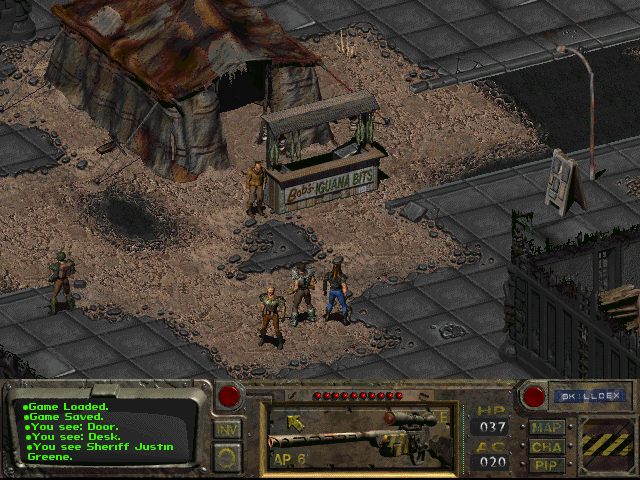
At this point it is clear that fictional worlds like that of Tolkien are nothing else but a collection of meanings belonging to a frame. For example the expressions "the Shire", "ring wraiths" or "the one ring" have certain meanings associated to them in the LOTR-universe, which are different to their everyday meanings (if those exists at all). This LOTR-frame of interpreting is activated, for example, by certain book titles. And, as crossmedia storytelling demonstrates, the frame doesn't even have to be bound to a specific medium. However many fictional worlds are experienced by us through mediums, and since I'm dealing here with games, I shall make an abbreviation for them: Fictional world belonging to a game will I call game world.
 |
| Fallout 1's visuals suggest interpreting them as a post-apocalyptic game world (source). |
To conclude this part, here are a couple interesting threads which I might continue another time:
- Fictional worlds are never unattached to reality. They are only a second meaning to something real, and this second meaning cannot come out of nothing: It was inspired by something real learned beforehand.
- Fictional worlds can be seen as a new kind of reality, but these realities can be distinguished, I think, by the fact that fictional realities are created on top of our normal reality.
- Computer games often create audio-spatial worlds in which we may project ourselves via the player character.
- Immersion and flow are, among other, dependent on the player embracing the frame that ís needed to see/read/.. the fictional world.
- Computer games use video, audio and player inputs to present us signs (video, audio) or opportunities to generate signs (input). Some of these communication canals might be more suited for some tasks, than others.
Quests, being a part of games here, provide the player with events and goal-inducers. Since both events and goal-inudcers can be meaningful, quest design thus too can use the whole history of meanings that are but a second meaning to their sign in a frame. And this is a lot: Games, stories, jokes, archetypic symbols, paintings, ...
But it also becomes clear at this point that, if a quest aims to use several of these areas, then it might be useful to distribute tasks at this point. Let's say for example a quest aims to tell a story in an audio-spatial game world with properly animated characters and integrated gameplay. Then already you might want to have at least an animator, gameplay designer, audio designer at your side, maybe more (character, level, dialogue writing might be separated too). These quick thoughts show already the importance of teamwork in quest design: In such a work distribution all participate in the construction of opportunities for interpretation and action, and if these opportunities are not consistent among each other, then the player might not be able to fully appreciate the game world.
So, here we are. I have explained how (I believe that) fictional worlds work, and now we shall re-visit one such world: The alternate history of Assassin's Creed.
An "Assassin's Creed" Quest - Context:
In the last post I wrote down ideas to turn the game's flag collecting into a player guide during small quests distributed over the maps. To start, I have chosen to make a quest located in the map Acre, more specifically in the Poor's District. Here is a map of Acre with its districts and the flags in them:
In order to make a quest in this district, I will explore missions, narrative, level, audio and atmosphere of this district first. I will stick to the world of Altaïr here and not go into the game's meta story around Desmond Miles. My main source will be the
Assassin's Creed Wiki.
Altaïr is member of the so called Assassin Brotherhood, an organization that seeks "to ensure the survival of freedom, as it allows for the progression of new ideas and the growth of individuality". Assassins are firm enemies of the so called templars who strive to save humanity by controlling it. The first Assassin's Creed game resolves around Altaïr, who fell in disgrace in his order for acting not according to their creed:
- "Stay your blade from the flesh of an innocent."
- "Hide in plain sight, be one with the crowd."
- "Never compromise the Brotherhood."
Further key thoughts are skepticism ("Nothing is true, everything is permitted") and humanitarianism. The story of the game then is the laborious (he needs to kill nine templars) re-rise of Altaïr to his former status of a high-ranking assassin during which he changes in person and becomes a true assassin. On the way he learns about a plan connecting the templar leaders and is challenged at each templar death with a moral question concerning his creed.
Acre is a city in the so called Holy Land. In the game it is currently under control of the crusaders, who have established a presence and set up a gouvernment. The city has been location of several fights: many deseases and wounded people are shown. The atmosphere is rather dark and grey, it seams like death and war are in the air:
The templar leader in the poor district of Acre is Garnier de Naplouse, a doctor and Grand Master of the Knights Hospitalier, a militant, originally caring order of european knights who came to the holy land during the crusades. De Naplouse has set up a hospital in the district, which reminds of a cliché psychatric clinic in the early 20th century. There are evil-looking priests, crippled people walking around, guarded knights and screams of the mentally tortured to be heard.
Indeed, when Altaïr visits the city to kill him and starts collecting informations via several minor generic missions, it becomes clear that De Naplouse is actually doing experiments with his patients to try out the new cures. In line with the templar's principle "ends justify the means" he does not see any ethical problem in using people - in the opposite, he even "came to believe that the patients were nothing more than lost souls in
need of aid and that he had a responsibility to guide them however he
saw fit".
The main question of this game section could therfore be summarized as "Why not use the weak to do medical experiments advancing humanity?".
Concerning the level design of the poor district, there is actually rather little to say. It can be noted though, that the district is comprised mainly of flat buildings of which many are partly ruined. Some buildings are special and taller, like a church or the hospital. There are many benches, shops, columns, scaffolds around and all is enclosed by the city wall. Besides the buildings, the poor district is marked by many small long lanes and corners as well as several bigger squares that are markets, meeting places, or view points.
An "Assassin's Creed" Quest - Construction:
But now, finally, to the construction itself. When thinking of a small story for that quest, I considered the themes of the main story and of the specific district.
Sitting on a bench near an exit of the hospital for the purpose of observation, Altaïr notices a wagon rolling inside the hospital, guarded by knights. He wonders what the wagon transports and decides to follow its traces. The trace consists of crying people, knights who deal out threats or fight people and children asking their parents why someone has to go or whether he will return. In the end Altaïr understands that the knights abduct people for their experiments and decides to stop the transport by killing the guards of the wagon and eliminating three knights who are threatening people.
Now while the goals might be well marked by the minimap, the flags can serve as a supporting tool: Maybe it is better to not make them the main goal-inducers, but only help as a non-interface element. In the following graphic I have tried to sketch how the quest might be situated in the game world space: The violet line denotes the trace of the wagon, while the green crosses mark the position of flags.
I have, unfortunately, not been able to really test this idea and design/place concrete events in the environment, but this is how I would have done it:
- Walk the course in-game and mark fitting spots with a good distance between them
- Think of an event for each spot that fits into the environment (Is there enough space? Which character models to use? Where do they stand? Which animations? How to change the environment (e.g. houses)? What are the lines that are spoken?)
- Revise the flag positions, such that each event can be spotted when approaching a certain flag
I shall leave this design for now. Below I will talk about some learned lessons. But first:
Ideas for Feedback
- Did I apply the theory of semiotics correctly? Does it matter for my ideas?
- Was the amount of research I did for my quest design appropriate?
Conclusion
My faible for thinking, theories and writing them down caught me again: I did not intend to write so many words, but here I am. Nonetheless I'm not sad about it, it seems a rather funny thing to me, since the phenomenon of thinking about but not doing accompanies me for such a long time now. But now, Instead of lingering here, to the matter at hand:
The concept of different meanings seen in the same things is something I find quite intruiging. It opens such a huge possibility space! It is a playground, and you only have to learn how to use it. We are now in range of such things as stories, play, theatre or humor - and when I talk about stories and play, then we will (hopefully) finally find a proper theoretical place for quests to dwell in and deal with some more concrete concepts such as characters, goals, player/machine actions etc.
I am quite content with my Assassin's Creed quest, as far as it got: It felt right when I did the research and wrote how its narrative is constituted, and laying out the quest in the game world's space worked without a resistence. I have the impression that with a bit more work, this could easily be finished to a proper quest design.
Well, I think this is a good time for an ending: Until next time!