Showing posts with label cyberpunk. Show all posts

Saturday, 25 September 2021

#39 UI: Cybertext

"Substance before Style"

 Another post, another storytelling device: The user interface, or for short UI.

Principles of Interaction Design

On his website, Bruce Tognazzini gives a holistic (my favourite!) introduction to what he calls "interaction design". The background he is writing from is that of the great design, UI, UX (user experience) trends which came up with the arrival of digital interfaces. He writes about core topics such as aesthetics, anticipation and autonomy. Here's the link for anyone interested:

First Principles of Interaction Design

However, while Tognazzini is primarily interested in communicating correctly with the user, I as a storyteller am equally interested in the question of how to give the designed interface a style consistent with the narrative or: what options I have to tell a narrative via the interface.

I think the answers lie in all the gaps, the variables that are not determined by interaction design principles. Today's project will serve as a demonstration of this thought:

The User Interface of Cybertext

A recurring reader of this blog or a person studying game studies with me might remember this project. It is, essentially, an interactive novel enriched with some audiovisual and interactive features.

You'll notice that various elements are at times heavily inspired by Cyberpunk 2077, especially its UI (see e.g. this great portfolio). Note however, that this is an unofficial fan work and is not approved/endorsed by CD PROJEKT RED.

Before the actual game starts, the player is presented with a view allowing to determine
herself when the actual gameplay starts.
Also: Opens up a void, which wants to be filled. Color and character usage sets up the theme.
 

When pressing ENTER, the logo is faded in and distorted,
accompanied by an electronic, distorted sound. Link

The standard gameplay view is accompanied by soundtrack and has several
sub-elements with specific thoughts put inside.

The lines and boxes framing text, decision and quest UI have two-fold meaning: Once, they create the impression of a system that can be steered - this is especially reinforced by the line's fading in and out over time. Second, they create the impression of being boxed in, unable to break out of this system - a thought which is reiterated in the game's tutorial and ending, where seemingly corporate messages are delivered about how the game should be enjoyed, for instance. It tells the meta-story of this game.

Regarding the story happening inside the boxes, the right UI is a visualization of the non-linear quest graph with its current state and possible future events. It tells the story that is written down and decided on the left in a way that may generate interest in the future or alternatives.

The entire visual style with mechanical moving elements and a clear reference to Cyberpunk aesthetics sets the atmosphere, thus possibly helping with immersion.

Conclusion

Even if I'm surely no "native" UI designer or 2D Artist, I do am a little bit proud of my work. It feels coherent in the right way - and this, in the end, is what a good production should be like, I guess. Anyway. I would have uploaded the whole game on itch.io already and embedded it here, but I'm not sure yet whether I'm allowed to.

If you already found this post and want to play - stay tuned! As soon as I know more about the legal stuff I'll post this on Twitter with an updated post including the - possibly altered - game.

Until then, have a good time!

Thursday, 22 July 2021

#28 Storytelling and its Reflective Potentials

 Blog post #28 has arrived. It is in general about storytelling and specifically about how storytelling manifests in quests in the video game medium. I'll try applying a very central idea in my very own practical design.

Storytelling

The introduction to a definition for "storytelling" by the National Storytelling Network (NSN) emphasizes that storytelling is "an ancient art form and a valuable form of human expression".

This highlights that storytelling is indeed a cultural practice, and onw can easily imagine hunters / gatherer - communities sitting around a fire some thousand years ago with a hunter group telling of how they managed to slay that one bear but lost one man in the process. The same applies to several other kinds of stories of course.

However, the central definition of the NSN is somewhat more formal:

Storytelling is the interactive art of using words and actions to reveal the elements and images of a story while encouraging the listener’s imagination.

Now, the NSN clearly didn't think of movies, books, video games etc. because they are focused on oral storytelling. But I think it remarkable that nonetheless the terms interactive and action pop up. And ever more interesting: If we exchange some oral-specific words by more general ones, then we get a pretty nice and more general definition for storytelling:

Storytelling is the interactive art of using signs to reveal the elements and images of a story while encouraging the audience’s mind.

So storytelling is in its core about arranging, presenting, mise-en-scène of story-material. Storytelling means encoding a story and transmitting that to the audience, which decodes and processes it bit by bit.

Designer and Player tell Player a Story

Storytelling can happen in video games: Designer and player can encode story-bits into a game, and the audience (usually the player, but sometimes also e.g. viewers on Twitch) decode and process them.

This can happen in the form of quests: The quest designer might prepare connected, serialized events, goals, means of achieving and choices for the player who, by e.g. enacting events and deciding on things and solving problems, finally determines the story told.

The great potential and difficulty in this is of course the player's agency. The player is able to participate in the storytelling, to tell herself a story. What, by giving a player space to notice and look upon her - consciously and unconsciously - performed decisions, we as designers might even elicit reflective thoughts in the player.

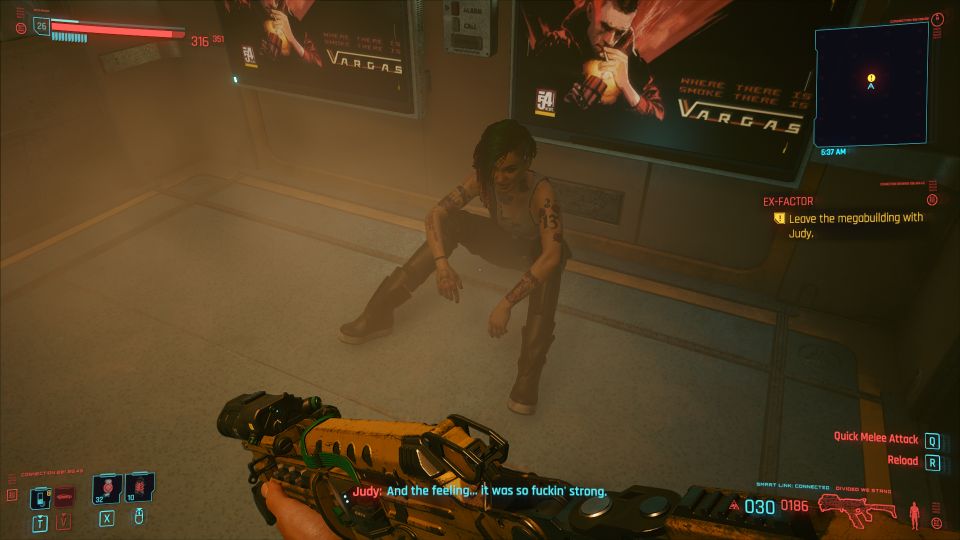
CP77 issued such a reflective feeling in me after killing someone supposedly bad by setting up a moment of rest and a character who mirrored my thoughts. Source

This, of course, works in other media too. Only, in video games it works very well, because the origin of action can be the audience itself by means of the avatar and and mechanics - which won't ever be the case in a book or movie.

Here some intuitive guidelines to set up storytellings that issue reflection in the player's mind:

  • Keep the player in flow while performing. We want to hit the player with Brechtian reflection afterwards, to elevate the effect. For now she shall execute her standard (possibly morally rationalized) behaviour.

  • Create a transitionary moment. The player needs to catch a breath and slow down, gather his thoughts process what happened.

  • Build a setting suited for reflection. This should be a safe space in the game world with appropriate level/audio/.. design, preferably with some other to converse with.
  • Steer player attention to reflection. Maybe a NPC or the avatar gives a comment, maybe there is a poster or a spatial constellation which refers metaphorically to the performed deed.

Designers and artists can play heavily with the story's archetypes, atmospheres, themes, symbols here to elicit the player's associations with them such that she may look and reflect upon them.

Further Reading / Inspiration

  • National Storytelling Network: What is Storytelling? Link

  • Post #22 Non-linear Stories Link

    A lot of inspiration and base work for this post is in here.

  • Wikipedia: Epic theatre Link

    Driven by - amongst others - Berthold Brecht, epic theatre "emphasizes the audience's perspective and reaction to the piece"

A Cyberpunk Storyquest - Setting up Reflections

Well, let's do something concrete:

A menace of matte gray, postmodernly deconstructed and rebuilt
A queen of power, a human, animal, an intersection of meaning
Silver flashes, lightnings on glassy dark
Untouchable and high
Evil eyes staring down

Eating you, the poor, the people, those who are

But you don't fear no more
1.) Throw the atomic warhead
2.) Don't throw it

1) You are shot down in masses
1) Auto DNA-ID ON-line Defensive Sys. ® Militech Corp.
1) There's a saviour amongst you
1) And he burns it down
1) Burns it all down
1) The whole damn city
1) People cry, the new gods die.

1) A new chapter of Anthroprocene begins
1) Warlords rise in the Ashes
1) Society collapsed
1) Much that once was is gone

1) And as you gather in your cave
1) The inner critic asks your soul
1) Was it me who's right?

You can see here how I set up the to-be-reflected action (throwing that atomic bomb) to be done in a flow state. After that, the action is loosing intensity and closeness until finally a very quiet image is provided with a concluding question functioning as reflection trigger.

Ideas for Feedback

  • Did you ever experience reflection on your own action in a game? Why?

  • Do you think you'd be left with such a feeling after playing that Cyberpunk quest? Why (not)?

Conclusion

This post has expressed on of my favourite thoughts about games. I guess it has appeared already in some other posts. It is, by the way, wuite an interesting feeling to slowly loose track of what I've written down and what not. Maybe this blog won't be a knowledge dump but rather a documentation of my conceptualization processes.

I hope you have a good time. Until the next post!

Wednesday, 7 July 2021

#27 Suspense

While we dived into enduring things last time, today I'm going to write about how to use those things which aren't there yet. It is about the feeling called suspense. Afterwards, I'll apply my learnings in an unexpected manner.

Suspense

That, of course, was a lie. But it showcases what I mean: The feelings that arise in an audience when there is an unresolved conclusion, a missing tone in a harmony, a foreshadowing, an interesting mystery.

On the designer side we're talking again about expectation management, about which I previously wrote a blog post. There I differentiated an expectational arc into promise, progress and payoff. The promises were divided into meta-promises (setting up the style of the work), world-knowledge (setting up the storyworld) and hypothesises, which are all expectational arcs related to how the story unfolds. One could say they are concerned with questions and statements such as:

  • "What happens next?"
  • "Probably X will happen"

This is what storytelling, to my knowledge, is interested in: The dynamics in the audiences heads while the story is told to them and of course - how to create which ones.

In my previous post I also wrote that "expectation management fundamentally breaks down to the gaps between":

  1. how it really is - story
  2. what informations are presented/revealed - plot
  3. what is understood - player's mental model

Furthermore: "Storytellers [..] may use the gap between points 1. and 2./3. to make a story more compelling through interesting reveals at the right time (pacing) and subversions".

Now, one way of creating interesting reveals is to make a prominent and meaningful promise, dragging the progress slowly but steadily while keeping on promising prominently, and creating a final reveal.

I'd label the feeling felt while progress is building suspense. It is on the same page as moments of intensity, of "holding ones breath" or not being able to see what'll come next.

What will happen to the man? What is the kid's role?

There surely are other such patterns: I'm thinking of surprises, plot twists, the calm before the storm, a moment of rest and such things.

But for today, let suspense be me guide.

Further Reading / Inspiration

  • #20 Expectation Management, link. The basis for this post, containing the sources to concepts like promise, progressm payoff and hypothesis

  • The Building Of Stories, page 55 and following, link. A very nice explanation of what suspense is and how to create it

  • Bordwell, Thompson, Smith: Film Art, Chapter 3: Narrative Form. Great book that consciously differentiates between story and plot, and builds its advices based upon that.

A Cyberpunk Storyquest - Writing Suspense

Searching to get something finished, I'll continue on the cyberpunky storyquest I began last time, hoping that such a smaller project will be finished more likely.

What will I do? I'll write. The moments I present here are those where I wanted to create suspension:

The sun is setting in my back
Orange lights - no, red lights chasing me
Black and red, devils forms
Accelerating, catching up, surrounding me
Their hatred is approaching me

My senses on alert
What is it?
1.) That smell..
2.) Them sounds..
3.) Those vibration..

 ...

The constant beat
Again, again and again
My body a flash of violet and silver
A fiery violet heart, oceans of anger
Waiting to be unleashed
We need to press on

You and me, my military friends
You'll drive me into my abyss, your abyss with your whips of steel

In the first case it's about withholding what it is, that's following the avatar (which is revealed when choosing any decision line), in the second case the player might wonder more intensively what his avatar is acually up to.

Ideas for Feedback

  • What other patterns of expectation management (like suspense, twist, etc.) come to your mind?

  • Are my writing samples not clear enough in their promise to be suspenseful?

Conclusion

This post had a very nice topic and leads into a direction that I'd like to pursue further. There are already several possible related topics on my mind.

There is a certain suspense to life itself too, I'm realizing. What will happen with me and those dear to me? Although I of course know of the parallel between plot/story and life, this thought never came to my mind before.

Granted, for me, a certain suspense does surround my next post.

Until then, have a good time!

Friday, 2 July 2021

#26 Durability and Impact

"Half a Century of Poetry"

Of late, I've been repeatedly thinking about why I actually write all these posts. Why did the bard Dandelion write all his ballads? Why do people write down all their thoughts into countless diaries, sheets of paper, books?

One answer to these questions lies in the concept of durability, I believe.

Durability

That, which stays with us, even though the world and we ourselves might change - that is durable, persistent, it endures. The divide between duration and change is at the foundation of time, as can be seen in a previous post of mine on this topic where I found two ways to define time:

  • subjective: shows itself in the continous existence of observation and reality
  • objective: shows itself in the changes/durations that are happening in reality

Note that actually both definitions formulate time based upon the dualism of change and duration. The second one does this in an obvious way, the first implicitly refers to that with the term of continuation - in opposition to non-continuation which essentially is change.

Impact

Those things that are not or slowly changing have a more unconscious, contextual, surrounding impact. They are a room of many lower perceptions, background chatters that accompany us. If something is there only for a short time, then it grabs our attention, stands out due to its movement - it is more punctual, more embedded in the main thread of our stream of consciousness.

** A valuable lesson for quest design is thus: Use the players budget of unconscious and conscious perception capabilities such that she and you can author her the desired experience. **

The division between unconsciously/contextually and attentively/consciously
perceived information can be found in this Inception poster: Compare the
trees/cars with the main characters and street.

For quest design this is actually one of the central things to mind, if I think about it. Let's look at a formulation of the nature of quests again:

a series of connected goals and events, where subsequent elements are only revealed, when a previous event has happened (which includes reaching a goal)

The important components of quests are goals and events, where an event describes a change and a goal describes a striven for change not having happened. But there is an extra layer to this that we may perceive: Recurring changes, so the same or similar changes happening. In such a rythm of recurring changes in a timeline durability is present.

One of the main tasks of the quest designer seems thus to build changes and durations. I think that merely showing something often and preferably to the players conscious senses makes the thing more outstanding to him.

** So a second advice I'd give my future self is: Across all the changes happening in a quest, keep showing those things which should be the driving components of the quest enacted by the player. **

Let's see, if I can use those thoughts in practice.

Further Reading / Inspiration

  • Henri Bergson: Matter and Memory, see e.g. the corresponding wiki-article

  • Totten, Christopher W. (2019) An Architectural Approach to Level Design. Especially the chapter on rythm, pacing and structure.

A Cyberpunk Storyquest

For a course at my university I've been developing a quest/progression system, which I presented earlier here on this blog. Because it seemed fun and to showcase the system in a more focused context, I transferred it to some kind of a interactive novel that has serious Cyberpunk 2077 vibes.

I enjoy those colors.

A feature added are sub quests: There are now certain nodes in which you can enter a sub sequence of nodes. Planned features are a sight radius of visible nodes, a visualization of different node types and possibly a fmod integration (that would be cool). Here I want to write a story-quest for that project.

In the story, the avatar is on the run through a city, experiencing several moments of thought, emotions and external events on the way. While the story progresses and branches, immersion in the character is more easy due to staying with him/her so long. Slowly, the characters motivations and intentions are unraveled, drawing the player into roleplaying (like, actually playing the role).

The story shall be composed of several parts, maybe short-stories, the initial one defined by two questions: What are we up to? Will we achieve it?

Unconsciously, the constant, goal-oriented running through the city shall be the main topic, that endures most of the time. Consciously meeting the city and the avatar's inner shall be of concern.

I'll write down the story in section summaries. A section looks somewhat like this:

You're running
Faster and faster
The neon city lights shining
oh so bright

Each of these lines will probably have a separate blend-in. But now to the structure:

  • You're running in a cyberpunky city
  • Something is on your mind
  • There's violence nearby
    • Keep going
    • 1) Disturbed run
    • 1) Wasted opportunity of showing your fighting-power
    • Stop it
    • 2) You efficiently and powerfully disturb the violence
    • 2) An extra sprint is necessary
  • The avatar believes in his/her rising
  • Is being worth it?
    • Is life worth being?
    • Is love worth being?
  • Numbness, no answer
  • A moment of being tired
  • Trotting on, but wait...
    • That smell...
    • 1) The smell of totalitarism
    • Them sounds...
    • 2) The sound of oppression
    • Those vibrations...
    • 3) The movement waves of militech
  • Something's off - the pursuers?
  • Turning up the speed
  • Images of capitalistic force - an abyss:
    • Let the streamlined winds of speed guide you
    • 1) Muscles of steel accelerate, you sprint over the abysses air
    • Touch the earth and ascend
    • 2) Metal touches asphalt, hydralics press you into air
  • A bridge is shattering, the first prophecy of machine fulfilled
  • You take in all that is around you, rise up a hill
  • There is the king, a tower of matte gray and silver-white pillars
  • Determined reaching of the goal
    • You throw the atomic warhead
    • You run into hell's gate
  • The explosion
  • The aftermath
  • The ending line

Implementing this in the system would be rather tiresome, since every separately blended in line would need an event that has to be set up and wired manually - without visual scripting. That's why I won't do this now. Another reason is that I've written only the outline here, but actually lines are only there until (including) "A moment of being tired".

Ideas for Feedback

  • What other design principle might be formulated on the basis of the duration/change dualism?

  •  The short story is intended to be rather fast-paced. Do you think the concept might work?

Half a Century of Poetry

Granted, I didn't write about durability right now out of interest alone (even though I (guess one perceives that) do am intrinsically interested). This post carries the number 26 in its name, which is the half of 52, which is the number of weeks in a year.

Meaning, my "one quest design a week" is halfway through. What remains of the first half? What will remain at all? / What durability will this blog's content have?

To answer the first question: Well, a small encyclopedia of preserved thoughts for one. As I stated in the conclusion of post #24, a motivation for this is probably in the somewhat self-expressive need for putting thoughts down, develop and synthethizing them. Communicating those things to others is rather a nice side-effect.
Secondly, a feeling of achievement is there. I've written 26 posts with theory and practical share and I'm proud of each of them (even though some are more dear to my heart). Many of the theoretical things have brought advancements in my own thinking about the topics. I know from those blog statistics that I'm not the only one reading my ramblings. I've received feedback one or two times, and it was positive. I've been able to use the posts to advance my other projects. And, most importantly, I feel more confident doing quest design.
On the other hand: I'm missing bringing a quest from idea to implementation here. I tried doing this with that Witcher quest, but I didn't even finish the design phase yet. Maybe this just isn't the right environment to do this.

What will remain at all? I strongly believe that the positive effects noted above won't fade away. Whether my practical goals will be achieved better, I don't know yet. I'm unsure if the blogging will continue when the project is completed - a casual post here and there might be something. I'm hoping to improve, solidify my quest design skills and reach a certain level of competence. Like, being able to quick and dirty design and implement a quest in a selected range of engines, given any idea.

Freedom of Thought         

I'm sure this won't be a work like Julian Alfred Pankratz viscount de Lettenhove's "Half a Century of Poetry", especially not in importance for the history of word in its world. But I do feel - for myself, I don't expect others to feel this - a certain beauty in this. A beauty of allowing myself to progress and express in my very own way - chosen based on freedom.

Conclusion

The tempo isn't fast and decreases in small steps only, but I think the rate of posts on time is drawing close to zero. I'm missing a post on pacing and rythms yet, might be that there's something coming from that angle. We might also meet endurance again if I say something about cycles in (between) game/gamer or if I would take a look at memory.

Writing about this is very fascinating to me, because it is so closely tied to matters of life and death - when I'm dead, my self no longer endures, or at least I think so. And what endures in my self while I live, that is, what is relevant to me. And if it shows in my consciousness, then I can inspect that.

Well okay. There was also that Cyberpunk 2077 inspired short-story-side-quest-thingy, where I wanted to inject some design principles. But I realized, that the injection doesn't work when planning the high-level sections, but only when doing the concretest work, e.g. writing lines and decisions in this case. I'd like to finish this, but I fear that I'm kinda not doing quest design then any more: That is rather operating on that higher level. Ah, to have a writer who'd do that for me.

Enough talk for this already (again) long and thought/text-heavy post. I'm thankful for you, unknown reader, who might have discovered/seen and read this. I hope you found something of value.

Have a good time!