Showing posts with label interactivity. Show all posts

Thursday, 22 July 2021

#28 Storytelling and its Reflective Potentials

 Blog post #28 has arrived. It is in general about storytelling and specifically about how storytelling manifests in quests in the video game medium. I'll try applying a very central idea in my very own practical design.

Storytelling

The introduction to a definition for "storytelling" by the National Storytelling Network (NSN) emphasizes that storytelling is "an ancient art form and a valuable form of human expression".

This highlights that storytelling is indeed a cultural practice, and onw can easily imagine hunters / gatherer - communities sitting around a fire some thousand years ago with a hunter group telling of how they managed to slay that one bear but lost one man in the process. The same applies to several other kinds of stories of course.

However, the central definition of the NSN is somewhat more formal:

Storytelling is the interactive art of using words and actions to reveal the elements and images of a story while encouraging the listener’s imagination.

Now, the NSN clearly didn't think of movies, books, video games etc. because they are focused on oral storytelling. But I think it remarkable that nonetheless the terms interactive and action pop up. And ever more interesting: If we exchange some oral-specific words by more general ones, then we get a pretty nice and more general definition for storytelling:

Storytelling is the interactive art of using signs to reveal the elements and images of a story while encouraging the audience’s mind.

So storytelling is in its core about arranging, presenting, mise-en-scène of story-material. Storytelling means encoding a story and transmitting that to the audience, which decodes and processes it bit by bit.

Designer and Player tell Player a Story

Storytelling can happen in video games: Designer and player can encode story-bits into a game, and the audience (usually the player, but sometimes also e.g. viewers on Twitch) decode and process them.

This can happen in the form of quests: The quest designer might prepare connected, serialized events, goals, means of achieving and choices for the player who, by e.g. enacting events and deciding on things and solving problems, finally determines the story told.

The great potential and difficulty in this is of course the player's agency. The player is able to participate in the storytelling, to tell herself a story. What, by giving a player space to notice and look upon her - consciously and unconsciously - performed decisions, we as designers might even elicit reflective thoughts in the player.

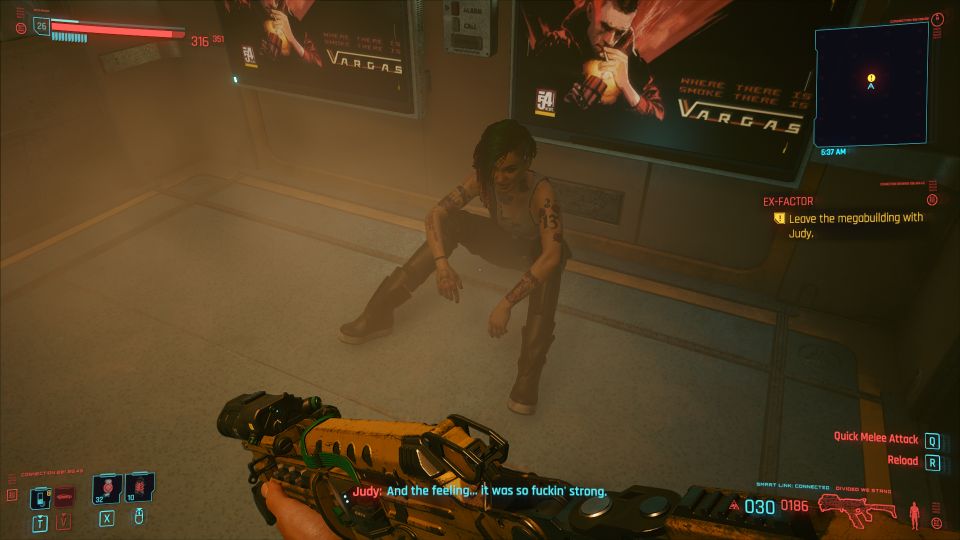
CP77 issued such a reflective feeling in me after killing someone supposedly bad by setting up a moment of rest and a character who mirrored my thoughts. Source

This, of course, works in other media too. Only, in video games it works very well, because the origin of action can be the audience itself by means of the avatar and and mechanics - which won't ever be the case in a book or movie.

Here some intuitive guidelines to set up storytellings that issue reflection in the player's mind:

  • Keep the player in flow while performing. We want to hit the player with Brechtian reflection afterwards, to elevate the effect. For now she shall execute her standard (possibly morally rationalized) behaviour.

  • Create a transitionary moment. The player needs to catch a breath and slow down, gather his thoughts process what happened.

  • Build a setting suited for reflection. This should be a safe space in the game world with appropriate level/audio/.. design, preferably with some other to converse with.
  • Steer player attention to reflection. Maybe a NPC or the avatar gives a comment, maybe there is a poster or a spatial constellation which refers metaphorically to the performed deed.

Designers and artists can play heavily with the story's archetypes, atmospheres, themes, symbols here to elicit the player's associations with them such that she may look and reflect upon them.

Further Reading / Inspiration

  • National Storytelling Network: What is Storytelling? Link

  • Post #22 Non-linear Stories Link

    A lot of inspiration and base work for this post is in here.

  • Wikipedia: Epic theatre Link

    Driven by - amongst others - Berthold Brecht, epic theatre "emphasizes the audience's perspective and reaction to the piece"

A Cyberpunk Storyquest - Setting up Reflections

Well, let's do something concrete:

A menace of matte gray, postmodernly deconstructed and rebuilt
A queen of power, a human, animal, an intersection of meaning
Silver flashes, lightnings on glassy dark
Untouchable and high
Evil eyes staring down

Eating you, the poor, the people, those who are

But you don't fear no more
1.) Throw the atomic warhead
2.) Don't throw it

1) You are shot down in masses
1) Auto DNA-ID ON-line Defensive Sys. ® Militech Corp.
1) There's a saviour amongst you
1) And he burns it down
1) Burns it all down
1) The whole damn city
1) People cry, the new gods die.

1) A new chapter of Anthroprocene begins
1) Warlords rise in the Ashes
1) Society collapsed
1) Much that once was is gone

1) And as you gather in your cave
1) The inner critic asks your soul
1) Was it me who's right?

You can see here how I set up the to-be-reflected action (throwing that atomic bomb) to be done in a flow state. After that, the action is loosing intensity and closeness until finally a very quiet image is provided with a concluding question functioning as reflection trigger.

Ideas for Feedback

  • Did you ever experience reflection on your own action in a game? Why?

  • Do you think you'd be left with such a feeling after playing that Cyberpunk quest? Why (not)?

Conclusion

This post has expressed on of my favourite thoughts about games. I guess it has appeared already in some other posts. It is, by the way, wuite an interesting feeling to slowly loose track of what I've written down and what not. Maybe this blog won't be a knowledge dump but rather a documentation of my conceptualization processes.

I hope you have a good time. Until the next post!
Tuesday, 1 June 2021

#22 Non-linear Stories & The Witcher 3

Today I'm doing some theorizing on non-linear stories, finding a few design guidances usable for them - in particular those involving consequential player choices. The third part will cover how I change my witcher quest design to better accomodate those guidelines.

Non-linear Stories

At this point, I'd like to present some terms more "scientific" than "non-linear":

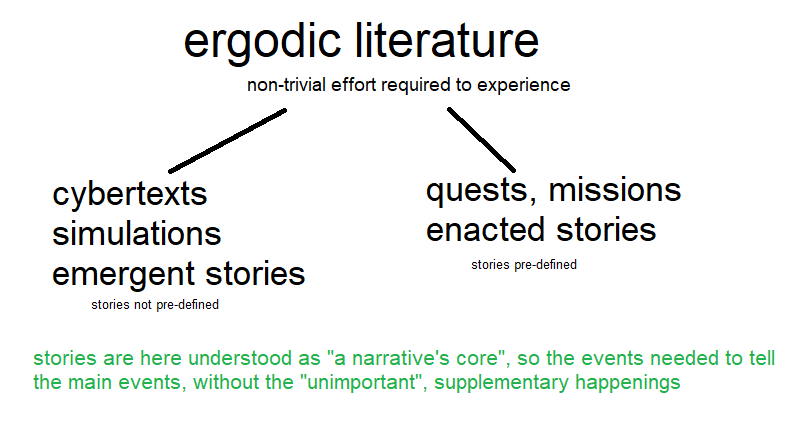
"In ergodic literature, nontrivial effort is required to allow the reader to traverse the text."

For example, ergodic literature is any text adventure where you are faced with decisions of what command to type next. This stands in opposition to books or movies where "what comes next" is usually quite clear. So an ergodic story is any story which you are not passively experiencing, but in which you have to give an effort to let the storytelling progress.

Cybertext is a form of ergodic literature, in which the text is determined by the interplay of a sign pool, a machine and an operator. So here interaction is of great importance: The "reader" takes part in creating the story, he participates in the storytelling. This is the case in many simulation games or games with a complex, dynamic system, where the concrete story cannot be predicted because the possibility space is just too high. Stories produced in such a way might also be called emergent.

If, on the other hand, all possible stories told by some computer game (being ergodic literature) are known from the beginning, then we might call these stories enacted. Quests and missions are very close to this type of story, since they define the key events and let the player progress through them with less important things being acted out by the player and only some (few) more important things being decidable.

Even though emergent stories have their own charm, we are on a quest design blog here, so this is why I'm mainly gonna focus on enacted stories here.

In ergodic stories, the audience enables the storytelling to progress.
Enacted stories allow the audience to choose between different branches.
Emergent stories let the player create her/his own stories.

As you can see, I understand story as "a series of related events" being part of a larger narrative which contains all minor happenings. For example, a character's mentor figure dying is most likely part of the story (and therefore narrative), while a character unconsciously moving some foot muscle while working is most likely no event relevant for the core story. It is, though, a happening in the overall narrative. Take this second fancy graphic:

Note that the terms I used here certainly have many different meanings
and relations in other places...

Note how I distinguished the narrative (that which has to be unveiled and be discovered by the audience) from the narration (that which is presented, told to the audience, from which it interferes the narrative). Story and plot are the core of each, while the happenings are "accessories", supplements needed to give the story context, a place, scene, world etc. to dwell in.

So while those happenings are not part of that which we usually remember from a narration, they certainly are necessary to make important events possible.

Alright, enough theory. What about those practical guidelines I promised?

So, here we go. This is a synthesized compilation of properties that enhance the non-linear aesthetic of a story:
  • decisions with narrative meaning (there need to be (communicated) consequences)

    There's a great appeal in having the feeling to shape a story. If there is no meaning to the story, then the decisions affects irrelevant happenings only, which might be cool too, but not as cool as changing the story. Communicating the consequences of a choice is very important to let the player feel that (s)he has made an impact.

  • decisions that feel personal (make room for player expression in the choices provided)

    Even better than being able to shape a story is shaping a story in a way that fits yourself. And if a dialog wheel does not offer you a choice that expresses your thoughts, than one feels detached.

  • amount of content/advantages following different choices should feel balanced in proportion to risk or and effort put into the choice

    If this is not given, then player might feel the need to always choose a certain way, because they want to experience the "most" content.

  • different branches and quests should not be isolated from another, but intertwining, mingling

    In reality, series of events do not happen independently from another. And if you do one decision but not another, then it's unlikely that the resulting world state will be completely different. The world doesn't revolve around a single actor.

  • some choices that create dilemmas

    If every choice is obvious to a player, then those choices may become boring and feel useless. Some morally gray decisions enhance player involvement and allow for feelings such as guilt and proudness when addressed later.

  • delayed consequences: players need to commit to choices they made

    This important to prevent players from optimizing their playthrough by reloading. This destroys  the emotional bond to a decision. Note how e.g. german let's player Gronkh becomes heavily invested in a certain choice in The Witcher 3 because of that: Link

While I'm certain - well, actually I know that there some other things that could be listed here ~ but I won't research and write down all of them right now.

Further Reading / Inspiration

  • Espen Aarseth: Cybertext: Perspectives on Ergodic Literature Link to Wiki-Article
    This work introduced the terms "ergodic" and "cybertext".

  • Henry Jenkins: Game Design as Narrative Architecture Link
    From this paper I borrowed the terms "emerging" and "enacted" story.

  • Many of the guidelines stem from this talk by CD Projekt RED quest designer Phillip Weber

A "Witcher" Quest - Part 11: Consequences

When I considered the current structural outline of my Witcher quest design, then I realized an inbalance concerning the amount of content following the first big choice. Furthermore, looking at the second big decision the consequences weren't really delayed, but rather immediate.

The story structure, as it was until now.

Let's fix that real quick:

The story structure, as it will be from now on.

So, what changed?

  • the content following the first grand decision is now balanced

    Both branches now have a roughly equal amount of things happening and a balance in good/bad things happening. E.g. in branch "Alene" Alene is freed from that bad situation, but Geralt won't be able to find the right murderer without the village becoming violent. In branch "The Contract" Alene dies, but Geralt can present the right murderer in a peaceful way.

  • swapping the quest branch is now mirrored

    By allowing to change from branch "Alene" to branch "The Contract", more balance between both branches is achieved.
  • the first and second grand decision now both have delayed consequences

    The first decision set (whether to help Alene or not) determines the fate of Alene and which ending follows when Geralt brings forth the true murderer. The second grand decision determines whether the village will be released from the tension of an unsolved murder or not.

Ideas for Feedback

  • Did my theory of story/narrative/.. match your intuition on those terms? If not, what feels off?
  • Should I maybe delete the possibility to change quest branches after the first grand decision?

Conclusion

Thinking about narration as something which is "told to the audience" reminded me of a thought that I really like: In computer games, the player participates in the construction of his own experience. He is part of the medium. Thus, he basically is partly his own narrator. I think that's quite cool.

Also, having said that stories are "a series of related events" being part of the larger narrative, we easily see the relation to quests, being defined by me as

a series of connected events and goals, where subsequent event(s)/goal(s) are only revealed, when previous goal(s) have been reached or some event has happened.

which is indeed a very story-adjacent definition. Maybe I'll find some other definition to test against some time.

I also am quite happy with the guidelines I found and how I managed to apply them. Those really seem like very useful (heuristic) rules. I'd like to find some guidelines for story irrelevant decisions in the future.

Until then, have a good time!